The Shroud of Turin · Chapter 8 of 21
The scourging: the wounds of the back and legs
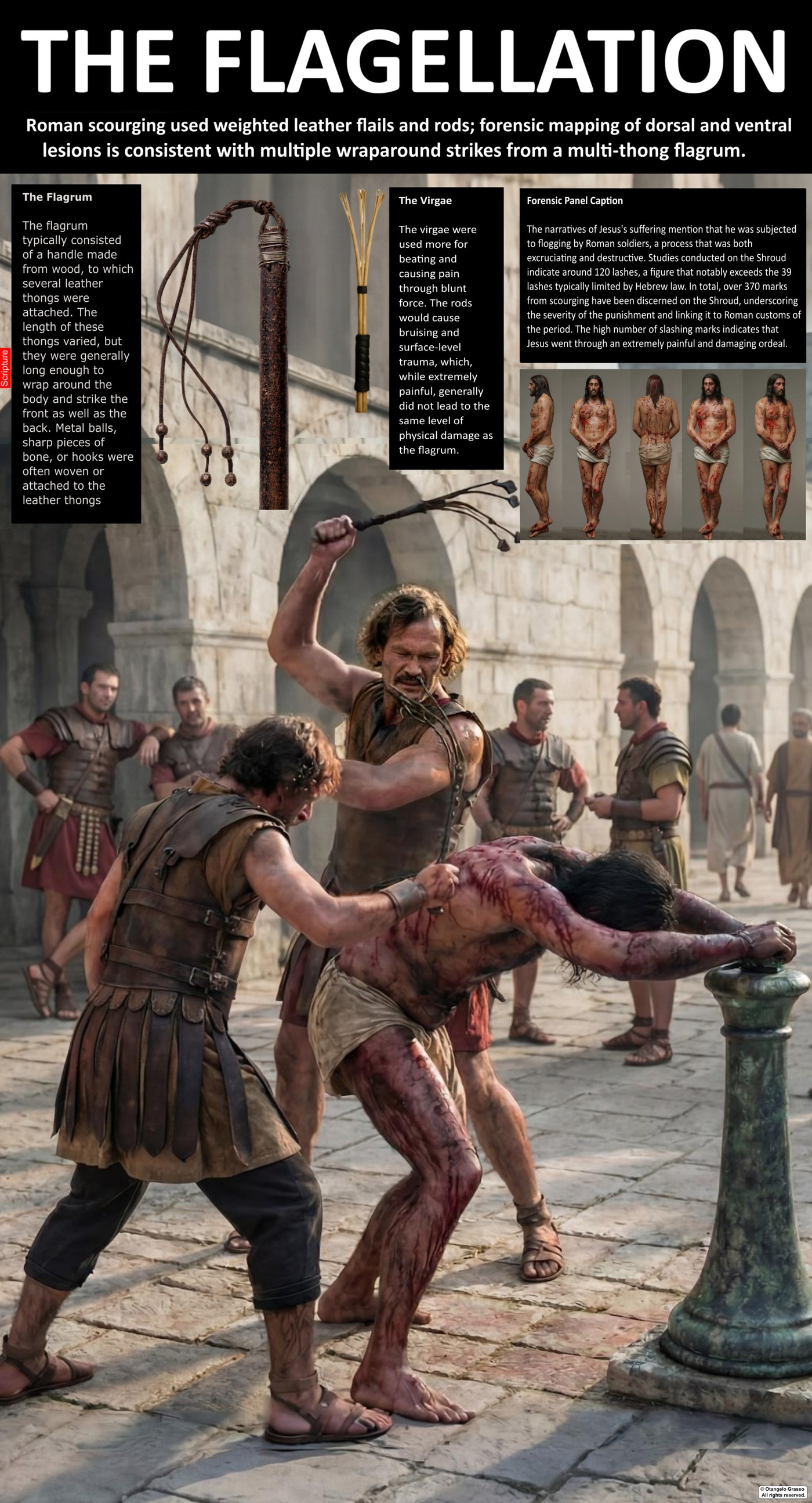
Before the cross, Jesus was flogged. The Gospels report the flogging in a single sentence, and the Shroud preserves the record of it on the back and legs of the figure in several hundred small, sharply defined marks. This chapter sets out what the Gospels say, what Roman scourging was, what the marks show, and how far the evidence supports any particular reconstruction.
What the Gospels say
The Gospels are brief. John writes that Pilate “took Jesus and had him flogged” (John 19:1). Matthew and Mark give the same outcome in similar words (Matthew 27:26; Mark 15:15).1 Luke alone gives a hint of Pilate’s intention. Pilate says three times that he finds no capital charge against Jesus and proposes to “chastise him and release him” (Luke 23:16, 22). The Greek verb Luke uses, paideuo, means discipline or correction rather than execution. If the flogging was meant to be the whole punishment, the soldiers were not meant to kill him, and what followed went beyond the original intent.
The Gospels do not describe the scourging in any detail. First-century readers knew what a flogging involved, and the writers did not need to say more.
Roman scourging
The Roman flogging that preceded crucifixion was a formal punishment carried out by trained soldiers. The usual instrument was the flagrum, also called the flagellum: a short handle to which several leather thongs were attached, each often weighted near its end with metal or bone. The weights made each blow tear as well as strike. The Roman writer Philo, describing a flogging in Alexandria, wrote of victims who were “lacerated with scourges,” and some died at once.2 The Alexandrian case is not Judean, but it shows the lethal potential of the punishment in general.
Edwards, Gabel, and Hosmer’s 1986 medical review described the mechanics of Roman scourging in detail. The weights on the thongs made each stroke tear the skin and the tissue beneath it, and the victim’s back, sides, and legs were all exposed to the lash.3 Surviving flagra from the Roman period have been recovered, including a specimen from the ruins of Herculaneum, which was buried in AD 79.4
Roman sources distinguished grades of corporal punishment, but the ancient terms were used loosely, so the modern sorting into grades should be treated with caution. A prisoner who was to be crucified would usually be scourged as a preliminary to the execution, and the flogging was intended to weaken him and to serve as a warning.
The place of the flogging
Christian tradition places the flogging at the Franciscan Monastery of the Flagellation in Jerusalem, near the site of the Fortress of Antonia. The Gospels say only that Jesus was taken to the praetorium, the official residence of the governor. Many historians and archaeologists now locate the praetorium at Herod’s Palace on the western side of the city, near the Jaffa Gate, which was the residence the Roman prefect would have used when he came to Jerusalem for the festivals.5 The identification is widely discussed and not settled, and the flogging could have taken place at either site, or elsewhere.
What the cloth shows
The marks appear on the dorsal image across the back, from the shoulders down to the calves, including the buttocks. They also appear on the frontal image across the chest, the abdomen, the thighs, and the legs. The neck and the groin appear to be free of marks, which fits a practice of avoiding places where a stroke could prove immediately fatal.6
Each mark is a small, dumbbell-shaped impression. Under ultraviolet light, the marks are sharper and show blood-related fluorescence, and the STURP investigation of 1978 reported that the sticky-tape samples from these areas contained clotted blood with serum separation.7 Some marks show fine parallel lines, which have been read as the trace of irregularities on the weights.
The number of marks has been counted several times. Earlier visible-light counts were in the range of 350 to 370. A 2025 study by Giulio Fanti and colleagues, using high-resolution photographs and the 1978 ultraviolet images, reported roughly 441 distinguishable marks, rising to nearly 500 when fainter and less certain marks were included.8 The same authors argued that the actual number of blows was higher, perhaps 800 or more, because the sides and inner surfaces of the limbs were never in contact with the cloth and left no imprint.8 These counts are interpretations of the image, and they depend on which marks are accepted. Counts should be read as ranges.
Reading the pattern
The distribution of the marks has been read in several ways, and each reading rests on assumptions.
- Shape. The impressions are described as dumbbell-shaped, with two or three small oval marks joined by a straight cut. This is consistent with a multi-thonged whip weighted at each tip, and it is consistent with the flagrum specimen from Herculaneum, though the correspondence is one of type rather than exact duplication.8
- Direction. The angles at which the impacts land relative to the body’s midline have been read as showing blows from two directions, consistent with two scourgers working together or one moving from side to side. This reading comes from the image geometry and has been argued by several analysts, but it is not a settled finding.8
- Position. Changes in the direction of the blood flows within the scourged area have been read as showing that the body was in more than one position during the beating, perhaps upright against a post and then bent forward.8
- Blunt injury. Some marks appear to lie under the dumbbell impressions, and have been read as earlier, blunter injuries, perhaps from the night in custody described in Luke’s Gospel.2 The evidence for an earlier layer is weaker than for the flagrum marks, and this reading should be held loosely.
Physiology of the flogging
Severe flogging can cause shock, through blood loss from many wounds, and it can cause more serious internal injury. Blunt force can damage the lungs, the heart, and the muscles. Edwards and colleagues describe the physiological consequences of severe flogging and of crucifixion in their review.3 The marks on the cloth show the external record, and they are only part of the damage a flogging of this kind would cause. Pierre Barbet argued that deep bruising, with no external bleeding, would leave no trace on a burial cloth, so the visible marks are a lower bound on the injury.9
The number of blows is also limited by the law of the time. Jewish law set a maximum of forty lashes, reduced in practice to thirty-nine, as Paul’s account of five floggings shows (2 Corinthians 11:24). Roman practice imposed no fixed limit, and the soldiers judged the number. The several hundred marks on the cloth exceed the Jewish limit, which is consistent with Roman practice and not with a Jewish flogging.
The paradox of the cloth
If the cloth is medieval, as the 1988 radiocarbon result suggested, its maker would have needed to know the form of the Roman flagrum, the way blood separates into clot and serum, and the way the wounds would be distributed. Those details were not widely documented until much later, and the blood chemistry was not measurable before the twentieth century.710 The forensic argument for an ancient origin depends on that improbability, and it is stronger when the marks are shown to be consistent with each other and with a single event.
The argument has limits. The 1988 radiocarbon result is contested, and some researchers have argued that the sampled corner was a later repair, a view that appears in the peer-reviewed literature.11 The forensic reading of the marks does not settle the date. It shows what the marks are consistent with, and the date must be decided on separate evidence.
What the flogging can and cannot show
The cloth can show that the body was struck by a multi-thonged, weighted instrument, that the blows were numerous and widely distributed, and that the blood on the marks has the properties of blood that clotted on the body. It can show that these features match the Roman flogging described in the historical sources. It cannot give the number of blows with certainty, identify the scourgers, or say whether the flogging was carried out in one place or several.
The flogging is one stage in a sequence. The chapters that follow examine the crown of thorns and the journey to Golgotha, which the Gospels place in the same morning.
References
- John 19:1; Matthew 27:26; Mark 15:15. John 19:1; Matthew 27:26; Mark 15:15. Luke 23:16, 22 for Pilate’s stated intention.
- Philo of Alexandria, In Flaccum, on the flogging of Jews in Alexandria. Translations and commentary are widely available. Publication details to be confirmed.
- Edwards, W. D., Gabel, W. J., & Hosmer, F. E. (1986). On the physical death of Jesus Christ. JAMA, 255(11), 1455–1463. doi:10.1001/jama.1986.03370110077025
- The Herculaneum flagrum specimen is described in the forensic and archaeological literature on Roman scourging. Publication details to be confirmed before publication.
- Herod’s Palace and the praetorium. The identification is discussed in archaeological and biblical scholarship. Publication details to be confirmed before publication.
- Marks on the cloth, as described in the forensic literature on the Shroud. Publication details to be confirmed.
- Heller, J. H., & Adler, A. D. (1981). A chemical investigation of the Shroud of Turin. Canadian Society of Forensic Science Journal, 14(3), 81–103.
- Fanti, G., Cardin, M., Cinquetti, V., et al. (2025). Shroud of Turin: Reverse engineering to reconstruct the tools that produced the scourge marks. Medical and Clinical Case Reports Journal, 3(4), 1487–1494. doi:10.51219/MCCRJ/Giulio-Fanti/417
- Barbet, P. (1953). A Doctor at Calvary. New York: P. J. Kenedy & Sons.
- Damon, P. E., et al. (1989). Radiocarbon dating of the Shroud of Turin. Nature, 337, 611–615. doi:10.1038/337611a0
- Rogers, R. N. (2005). Studies on the radiocarbon sample from the Shroud of Turin. Thermochimica Acta, 425(1–2), 189–194.