The Shroud of Turin · Chapter 10 of 21
From Gethsemane to Golgotha: the sequence of the Passion
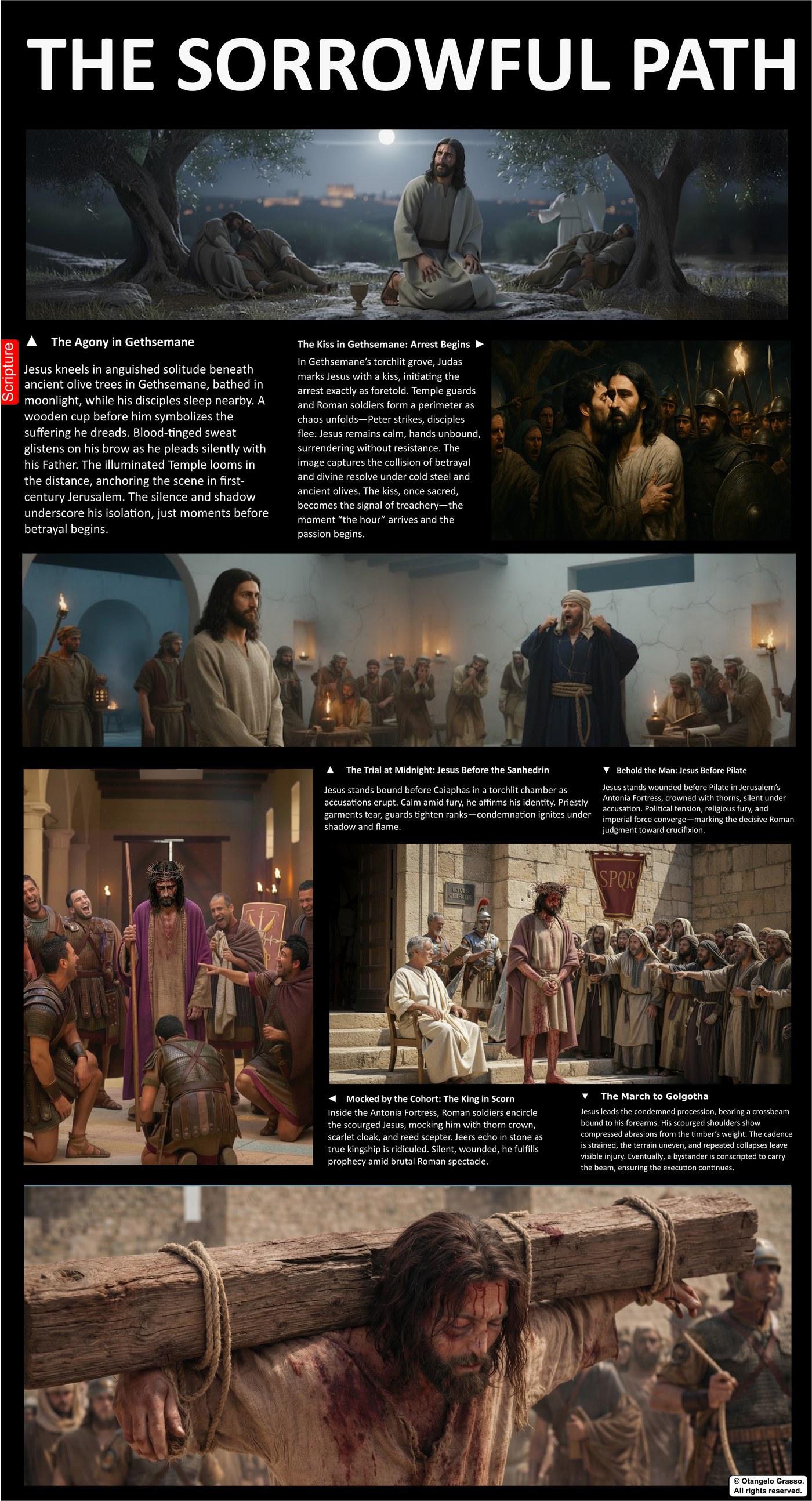
Between the arrest in the garden and the arrival at Golgotha, the Gospels describe a night of questioning and a morning of trials, a flogging, a mockery, and a walk through the city carrying a beam. The Shroud records some of the marks of that walk. This chapter follows the sequence, keeps the Gospel accounts separate from the physical evidence, and notes where the times are approximate.
The garden of Gethsemane
The Gospels place Jesus with his disciples in a garden on the Mount of Olives, called Gethsemane. Mark and Matthew describe him praying there, distressed, and asking that the cup be taken from him, while his companions slept (Mark 14:32–42). Luke alone describes him sweating drops of blood (22:44), a verse that some early manuscripts omit.1 Judas arrives with a crowd and identifies him with a kiss, and one of the disciples cuts off the ear of a servant of the high priest (Mark 14:43–47; John 18:10). The arrest follows.1
The garden is a traditional site, and the identification of Gethsemane with the place now marked on the Mount of Olives is a long-standing tradition. The Gospels do not give a precise location beyond the mount.
The night before the Sanhedrin
After the arrest, Jesus is taken to the house of the high priest Caiaphas, where the council gathers. Mark describes the questioning about his identity, the charge of blasphemy, and the mocking and beating that followed (Mark 14:53–65). John places a separate questioning before Annas, Caiaphas’s father-in-law, and Peter’s denial in the courtyard (John 18:12–27).2 The Gospels differ on several details of the night, and the differences are not resolved in the texts.
The Shroud evidence bears on this part only indirectly. The blows of the night are the subject of the beatings described in the Gospels. Whether they left marks distinct from the flogging that followed is not established on the cloth.
The morning before Pilate
In the morning, the council brings Jesus to the Roman governor, Pontius Pilate. John describes a sequence of questions inside the praetorium, the governor’s residence, and then the crowd outside, the choice between Jesus and Barabbas, and Pilate’s attempts to release him (John 18:28–19:16). Luke adds that Pilate, learning that Jesus was a Galilean, sent him to Herod Antipas, who was in Jerusalem for the festival, and that Herod returned him dressed in a mock robe (Luke 23:6–12).2
The Gospels place the trial in the praetorium without naming its site. Many historians locate the praetorium at Herod’s Palace on the western side of Jerusalem, near the Jaffa Gate. Others favour the Fortress of Antonia, which was north of the Temple. Both sites are discussed in the literature, and neither is confirmed by an inscription or other direct evidence.3
The flogging and the mockery
Following the Gospels, Pilate has Jesus flogged (John 19:1) and then handed over to the soldiers, who mock him as king. These two events are described in Chapter 8 and Chapter 9. In the Gospel order, the flogging comes first, and the crown and the robe follow.
The sequence matters for the cloth. The shoulder and back marks described in Chapter 8 are the record of the flogging. The scalp marks described in Chapter 9 are the record of the crown. Where the two overlap in time, the cloth does not say which came first.
The road to Golgotha
The Gospels say that Jesus carried his cross, or the beam of it, out of the city to the place called Golgotha. Mark names Simon of Cyrene, a man coming from the countryside, who was compelled to carry the beam (Mark 15:21; Luke 23:26). The usual Roman practice was for the condemned man to carry the horizontal crossbeam, or patibulum, while the upright stake remained at the execution site.4
Luke records the women who followed and mourned, and Jesus’s words to them about the destruction of Jerusalem (Luke 23:27–31). The route is traditionally marked by the Via Dolorosa, with stations that were established in the medieval period. The historical route is uncertain, and the traditional stations do not all rest on evidence from the first century.3
What the cloth records of the walk
The dorsal image shows marks that have been read as the trace of carrying a heavy beam. Two abrasions lie over the shoulders, one on the left shoulder blade region and a smaller, deeper one on the right. They appear to lie over the scourge marks, which would place them after the flogging. The abrasions are read as the friction of rough wood against damaged skin, and the asymmetry of the marks has been read as the beam resting more heavily on one shoulder.5 Those readings are interpretive, and the abrasions could come from other causes.
The knees show injuries that have been read as falls onto a hard surface. The left knee carries a contusion with broken skin, and the right knee shows a smaller, similar injury. A man who fell while carrying a heavy weight, unable to break the fall with his hands, would produce this pattern. The reading is plausible but depends on the interpretation of the image, and it has not been tested independently.5
The facial and head injuries are discussed in Chapter 9. They are consistent with blows to the face and with the crown, but the cloth does not separate them cleanly.
The timing
The Gospels give different times for the key events. Mark places the crucifixion at the third hour, about nine in the morning (Mark 15:25). John places Pilate’s final judgment at about the sixth hour, around noon (John 19:14). The two accounts differ, and both are reconstructions in their own terms. Timelines that set out the night and the morning hour by hour are estimates that combine the Gospels with assumptions about the distances and the pace of the procession.
The cloth cannot give a clock. Blood and body marks show the order of injuries in some cases, but not their exact times. Estimates based on the marks should be treated as approximate.
The threshold
The Gospels move from the walk to the place of execution with little comment. Mark says that they brought Jesus to Golgotha, which means the place of the skull, and offered him wine mixed with myrrh, which he did not drink (Mark 15:22–23). The next chapters take up the place of execution and the crucifixion.
What the sequence can and cannot show
The Gospels give a clear sequence of events, and the cloth carries marks that match several stages of it: the flogging, the crown, the carrying of the beam, and the falls. The match is consistent with the Gospel account, but the cloth does not record the Gospel sequence as a whole, and the times are estimates. The sites of the trial and of Golgotha are discussed in the literature, and they remain uncertain.
References
- Mark 14:32–47; Luke 22:39–53; John 18:1–11. Mark 14:32–47; Luke 22:39–53; John 18:1–11.
- Mark 14:53–65; John 18:12–19:16; Luke 23:1–12. John 18:12–19:16.
- The sites of the praetorium and of Golgotha are discussed in archaeological and biblical scholarship. Publication details to be confirmed before publication.
- Zugibe, F. T. (2005). The Crucifixion of Jesus: A Forensic Inquiry. New York: M. Evans and Company.
- Shoulder and knee injuries as described in the forensic literature on the Shroud. Publication details to be confirmed before publication.