The Shroud of Turin · Chapter 14 of 21
From the cross to the tomb: the burial and the face cloth
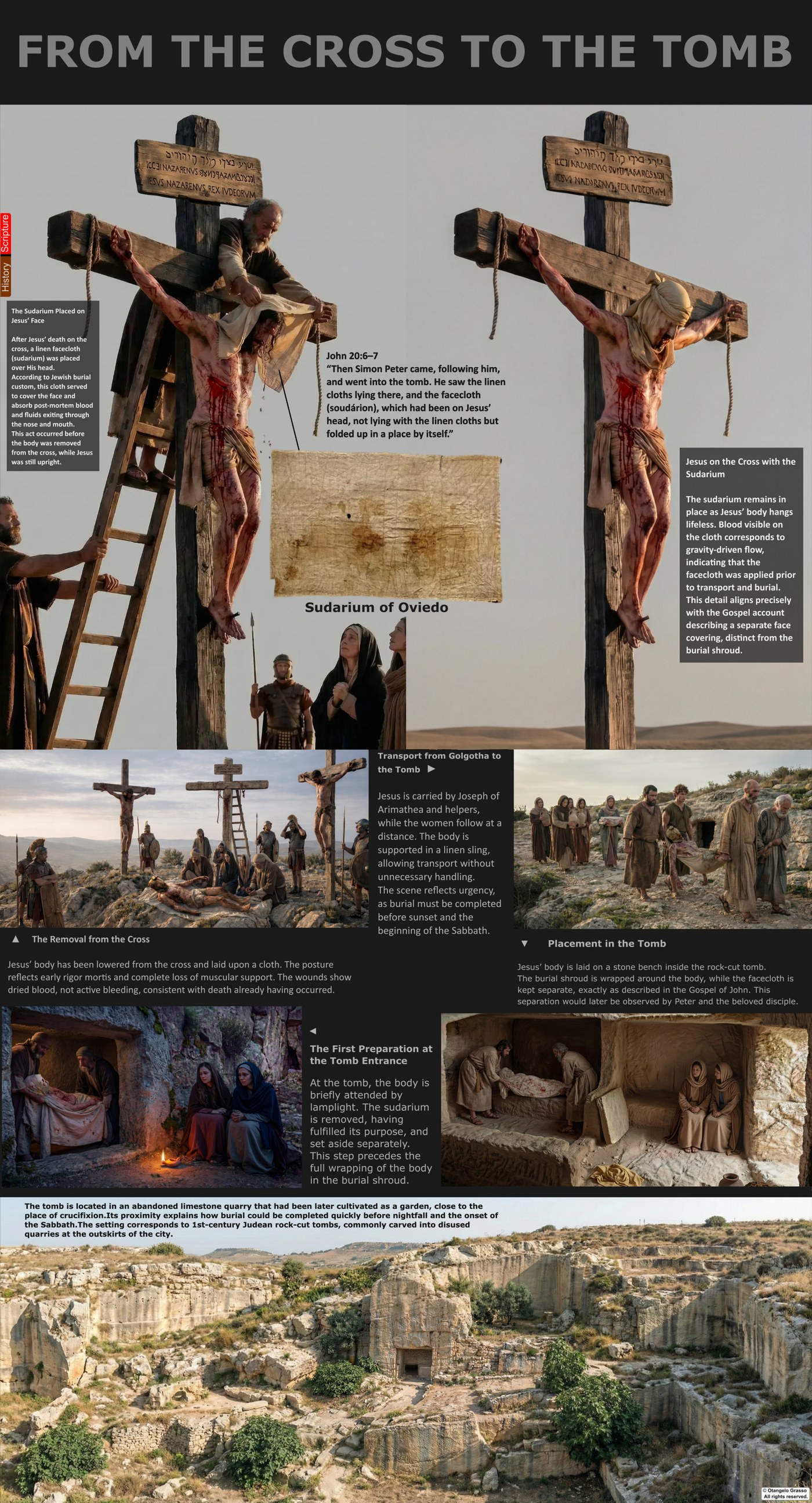
The Gospels say that Joseph of Arimathea asked Pilate for the body, wrapped it in linen, and laid it in a tomb before the Sabbath began. The Shroud is said to have wrapped that body. The burial is the point at which the body left the cross and the cloth began to record its contact with the body in its final form. This chapter sets out the Gospel account, the law and the time pressure behind the burial, the face cloth known as the Sudarium, and the limits of comparing the two cloths.
What the Gospels say
All four Gospels describe the burial. Mark says that evening had come, and that Joseph of Arimathea, a respected member of the council, went to Pilate and asked for the body (Mark 15:42–45). Pilate confirmed with the centurion that Jesus was dead and granted the request. Joseph bought linen, took the body down, wrapped it in the linen, and laid it in a tomb cut in rock, and rolled a stone across the entrance (Mark 15:46). Matthew and Luke give the same sequence with small differences (Matthew 27:57–61; Luke 23:50–56).1
John adds Nicodemus, who brought a mixture of myrrh and aloes, about a hundred pounds in weight. The body was bound in linen with the spices, according to Jewish burial custom (John 19:39–40). John also says that the tomb was in a garden, near the place of crucifixion, and that it was a new tomb in which no one had yet been laid (John 19:41–42).1
The law and the time pressure
The Gospels place the burial on a Friday, before the Sabbath began at sunset. Deuteronomy 21:22–23 required that the body of a person executed on a tree not remain overnight, and that it be buried on the same day. Mark and John stress the approach of the Sabbath and the preparation day (Mark 15:42; John 19:31, 42).2 That gave the burial a limited window, and the Gospels describe it as hasty.
A fuller burial would normally have included washing, anointing, and dressing, and those rites were not completed before the Sabbath. The women who came on the first day of the week intended to finish them (Mark 16:1; Luke 24:1). The sequence of the burial should be read with that in mind: the Gospels describe a burial that was completed in part, and then interrupted.
The body and the rigor
Rigor mortis, the stiffening of the muscles after death, begins within a few hours and lasts for a day or more. If the body was taken down and wrapped while the rigor had set, the posture at death could be preserved for a time. The clearest case for this is the arms, which were held out from the body as they had been on the cross. The overlapped feet and the position of the hands are read in the same way. The reading is a possibility, and it depends on the timing of the wrapping, which is not known.3
The Shroud also shows horizontal blood runs on the lower back. Those runs are consistent with the body being laid flat while the blood was still liquid, which fits the sequence of the burial. Some researchers have also read marks on the heels as consistent with carrying. Those readings are interpretive and should be held as such.
The Sudarium of Oviedo
John 20:7 mentions a separate cloth, which was on Jesus’s head and was folded apart from the linen wrappings. The Greek word is soudarion, from the Latin sudarium, a sweat cloth or face cloth.1 In Jewish burial practice after a violent death, such a cloth could cover the face during transport and absorb blood and fluid.
The cloth kept in the cathedral of Oviedo in northern Spain is traditionally identified with this face cloth. It is about 84 by 53 centimetres. It has a documented history in Spain from the early seventh century, and tradition links it to Jerusalem and to the Persian invasion of 614.4 That history predates the Shroud’s first documented appearance in France in the 1350s, and the two cloths have separate custodial histories. The identification of the Oviedo cloth with the Gospel face cloth rests on tradition and on the evidence of its stains.
What the two cloths share
Several features have been reported in the literature as shared by the two cloths. Both are linen. Both have blood stains that are consistent with a wounded face, with swelling and blood at the nose and mouth. Both have marks consistent with crown-of-thorns wounds, and both have blood of type AB in reported tests. Pollen and calcium deposits have been reported on both.5
The strongest claims come from point-matching studies. Alan Whanger, using his Polarized Image Overlay Technique, reported matches between blood features on the two cloths, and later computer-assisted analyses reported alignments of the nape and occipital regions after a rotation and scaling.6 Some of these figures come from conference proceedings, and they have not been confirmed in the peer-reviewed literature. They should be read as reported results.
The objection from counting
Counts of matching features can be misleading. A blood-stained cloth presents a very large number of measurable features, and a researcher who selects the features that match and reports only those can produce a high count without any real correspondence. A valid count needs the total number of features examined, a rule for deciding in advance which features count as a match, and a comparison against the rate of matches expected between two unrelated bloodstained cloths.
The Whanger counts were not produced under blinded and pre-registered conditions, so they cannot be read as independent probabilities. This does not mean the counts are wrong, and it does not show that the cloths are unrelated. It means that the counts do not, on their own, establish a common origin.
The objection from flat overlay
A common objection is that the stains do not line up when the two cloths are laid flat over each other. The response is that the Sudarium was folded and fastened around a three-dimensional head, while the Shroud lay on a flat slab. Different folding, tension, and handling would prevent a simple flat overlay from matching. The question is whether the stains converge once their handling is taken into account, and that has to be tested with explicit, pre-specified transformations.
What the two cloths can and cannot show
The Sudarium can show that a face bearing blood and fluid was covered with a cloth in the period it was used, and that the stains are consistent with a face that had suffered injury. If the cloths share a source, the correspondence should be tested under controlled registration, with the features and the transformations fixed in advance.
The two cloths cannot, on present evidence, prove that they covered the same face, because the counts and the overlays depend on methods that have not been independently verified. The chapter has set out the reported evidence and the limits of each claim.
The tomb
The tomb in which the body was laid is discussed in Chapter 11. The traditional tomb under the Church of the Holy Sepulchre lies in the same quarry complex as the reported site of Golgotha, and the Gospel accounts place the two close together. The next chapter turns from the burial to the linen the Gospels describe, and to what the Gospels say about the cloths that were found in the tomb.
References
- Mark 15:42–46; Matthew 27:57–61; Luke 23:50–56; John 19:38–42; John 20:7. Mark 15:42–46; John 19:38–42; John 20:7.
- Deuteronomy 21:22–23. Deuteronomy 21:22–23.
- Rigor mortis and its timing, as discussed in forensic pathology. See Zugibe, F. T. (2005). The Crucifixion of Jesus: A Forensic Inquiry. New York: M. Evans and Company.
- Sudarium of Oviedo. The history of the cloth in Spain and its identification with the Gospel face cloth are discussed in the historical and scientific literature. Publication details to be confirmed before publication.
- Reported features shared by the Shroud and the Sudarium. Primary publication details to be confirmed before publication.
- Whanger, A. D., and colleagues on the Polarized Image Overlay Technique, and later computer-assisted analyses. Several results appear in conference proceedings and have not been confirmed in the peer-reviewed literature. Publication details to be confirmed before publication.