The Shroud of Turin · Chapter 15 of 21
The empty wrappings: the linens in the tomb
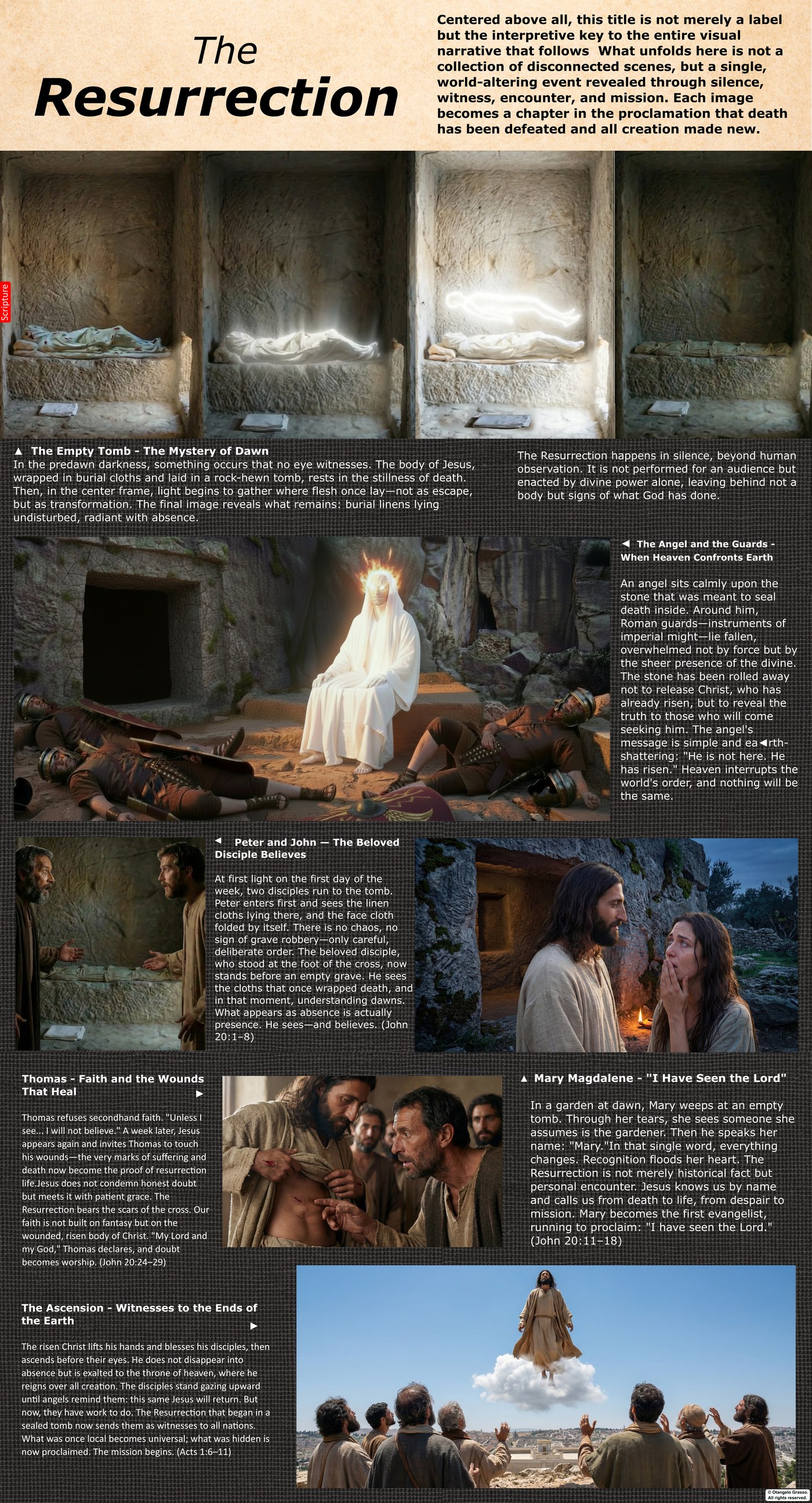
The Gospels say that on the first day of the week, two of the disciples went to the tomb and found it empty, except for the linen cloths and a separate face cloth. The description is brief, but its terms are precise, and the precision has been used to ask what the cloths looked like and how they were left. This chapter examines the words, the arrangement the Gospels describe, and the questions that can be put to the Shroud. It also marks the point at which the questions stop being forensic.
What the Gospels say
John gives the most detailed account. Mary Magdalene came to the tomb early in the morning and saw that the stone had been moved. She told Peter and the other disciple, who ran to the tomb. The other disciple arrived first and looked in, and saw the linen cloths lying there. Peter went in and saw the linen cloths lying, and the face cloth, which was folded and set apart from them. The other disciple then went in and saw, and believed (John 20:1–8).1
The Synoptic Gospels give a shorter account. Luke says that Peter went to the tomb, saw the linen cloths by themselves, and went away wondering (Luke 24:12). Matthew and Mark describe an empty tomb and a messenger, without mentioning the linens.1
The Greek words
John uses three terms. The first is othonia, a plural noun for the linen cloths used in burial. It describes the collection of linens together, not a single sheet. The verb John uses for the body being bound is edesan, which means that the body was secured within the linens (John 19:40). The second term is sindon, a single linen sheet, which the Synoptic Gospels use for the cloth in which Joseph wrapped the body (Matthew 27:59; Mark 15:46; Luke 23:53). The third is soudarion, the face cloth, which John says was folded and placed separately from the linens (John 20:7).2
John also uses the verb keimena, meaning lying, three times for the linens (John 20:5, 6, 7). The verb describes the cloths lying where the body had been, rather than strewn or torn. The Gospels elsewhere distinguish the linen bindings of Lazarus, which were keiriai, strips that had to be unwound (John 11:44). The vocabulary is consistent across the Gospel, and it is precise.
The arrangement
The Gospel account describes the linens as collapsed and lying on the stone where the body had been, with the face cloth separate and folded. Some readers take the description to mean that the body had left the linens without disturbing them. Others read it as a description of a burial in which the wrappings were removed in a particular order. The Greek is consistent with either reading, and the text does not settle the question.
The Shroud, if it is the sindon, would be the largest of the linens. The face cloth tradition is represented by the Sudarium of Oviedo, discussed in Chapter 14. Neither identification is established by the Gospel text alone, and each depends on tradition and on the evidence of the cloth.
What the Shroud can and cannot contribute
The Shroud is a single large linen, about 4.36 metres by 1.10 metres, woven in a three-to-one herringbone twill. The linen and the weave are discussed in Chapter 2. Its dimensions are consistent with a shroud of the kind the word sindon describes, and its weave is consistent with a fine burial linen. Those points are consistent with the identification, but they do not establish it.
The Shroud can contribute evidence about the body that lay in it, about the blood, and about the handling of the body. It cannot show that the body rose, and it cannot show that the empty tomb was empty for any particular reason. The forensic record ends where the question of the resurrection begins.
The disturbance argument
Some writers have argued that the Shroud shows no signs of disturbance, and that a body removed from the cloth by ordinary means would have smeared the blood. The argument has been made about the clots and the serum halos described in Chapter 3. The argument depends on the premise that a body removed from a cloth must disturb it, and on the claim that the Shroud shows no disturbance. Both premises are contested. The disturbance question belongs to the forensic evidence, and the chapter does not decide it here.
Where the forensic question ends
The Gospel account of the empty tomb is a claim about an event. The forensic evidence in the Shroud concerns the cloth and the body that lay in it. The two are related in the sense that the Gospels name the cloths, and the cloth bears the traces of a body. The forensic evidence cannot show what happened after the body left the cloth, and that question is one of history and of faith.
Readers who take the Gospel account as a claim about history can ask whether the textual details are consistent with an eyewitness account, and the attention to the cloths is one of the details that scholars have noticed. Readers who do not share the faith can still examine the Greek and the cloths on their own terms. The chapter has tried to keep those questions apart.
The next question
The next chapter takes up the cloth’s history from Jerusalem to France, and the documents and traditions that trace it between the first century and the fourteenth. That history is the least certain part of the record, and it is the part on which the authenticity debate most depends.
References
- John 20:1–8; Luke 24:12; Matthew 28:1–8; Mark 16:1–8. John 20:1–8; Luke 24:12.
- Greek terms othonia, sindon, soudarion, and keiriai as discussed in New Testament lexical and textual studies. Standard lexicons include Bauer, W., Arndt, W. F., Gingrich, F. W., & Danker, F. W. (2000). A Greek–English Lexicon of the New Testament and Other Early Christian Literature (3rd ed.). Chicago: University of Chicago Press.