The Shroud of Turin · Chapter 16 of 21
The hidden thread: from Jerusalem to Lirey
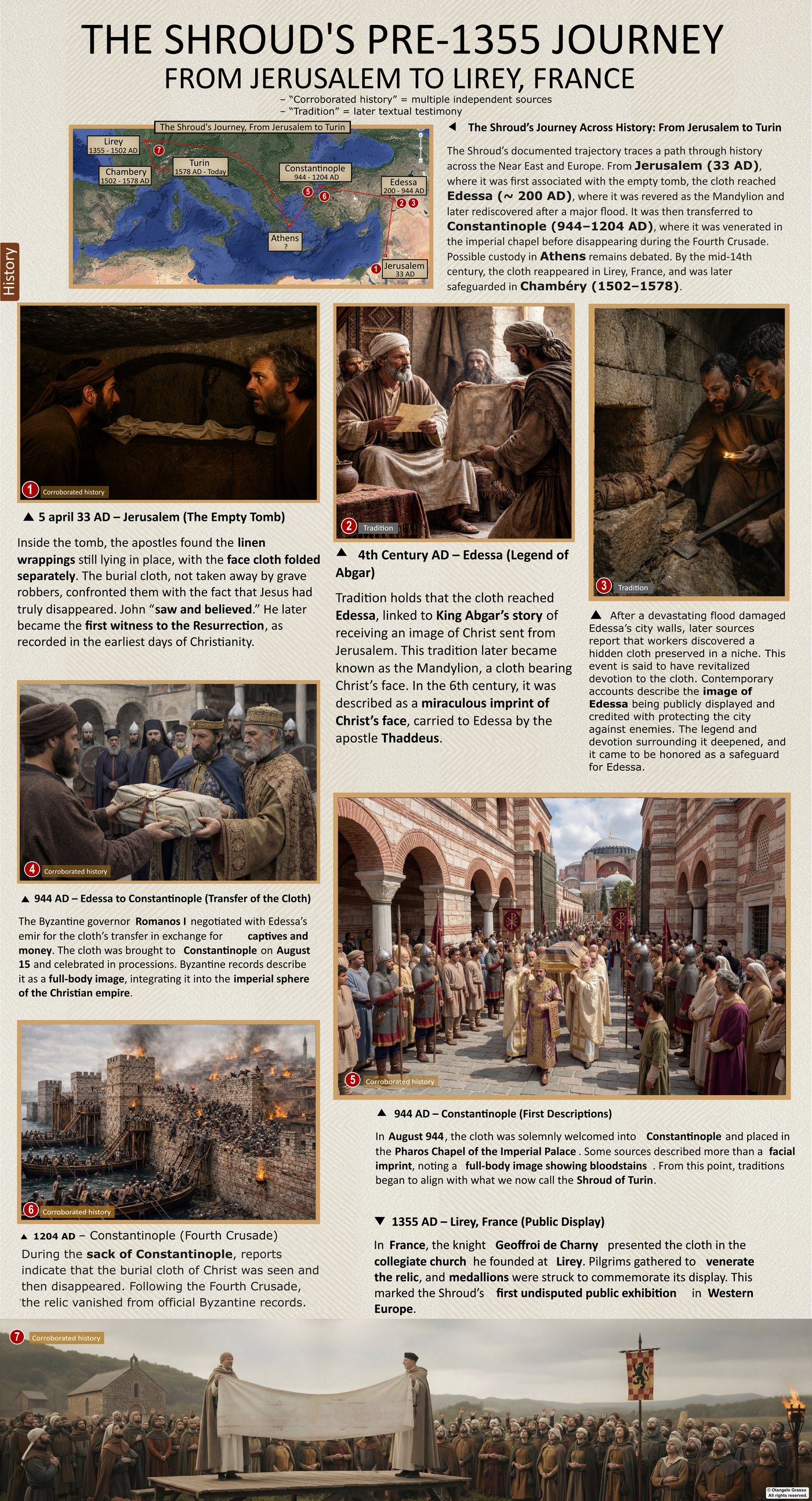
The cloth can be traced with some confidence from the mid-fourteenth century, when it appears in the record at Lirey in France. Before that, the story depends on a set of earlier identifications, some of them documented and some traditional. The most discussed is the link to a cloth called the Mandylion in Edessa and Constantinople. This chapter sets out what is documented, what is traditional, and where the gap is widest.
The legend of Abgar
The earliest link is a legend. The Greek historian Eusebius of Caesarea, writing in the early fourth century, reports a correspondence between Abgar, king of Edessa, and Jesus, in which Abgar asks for healing and Jesus promises a disciple to come. Eusebius says he found the letters in the archives of Edessa.1 The later Syriac Doctrina Addai adds the apostle Thomas and a portrait of Jesus. The legend of a miraculous image sent to Abgar appears in some of these later versions.2
The legend is not evidence that the cloth existed in the first century. It shows that the idea of a sacred image of Jesus was circulating in Edessa from an early date, and that the story of a miraculous image could be attached to a local cult.
The Mandylion in Edessa
By the sixth century, Edessa had a cloth bearing a face, which was kept in the city and venerated. Byzantine and Syriac sources describe a folded cloth, and the term Mandylion, a word for a towel or napkin, is used from the tenth century. Edessa was taken by Arab forces in the seventh century, and it remained under Muslim rule until 944.3
The description of the cloth before the tenth century is limited. Most sources describe a face image, not a full-length body, and the cloth was folded in a way that displayed only the face. This is the central difficulty for the link to the Shroud, which bears a full-length figure. Scholars have argued both ways about whether the folded cloth could have been the Shroud displayed in part, and the question remains open.4
The transfer to Constantinople, 944
In August 944, the Mandylion was taken from Edessa to Constantinople, and received with ceremony. The Byzantine account, the Narratio de imagine Edessena, describes the transfer, and a manuscript miniature shows the handover.3 The cloth was placed in the imperial chapel of the Pharos, in the Great Palace, and the date became a feast in the Eastern calendar.
This is the firmest point in the early record. The transfer is documented in Byzantine sources, and the cloth was then kept in the capital. The question is whether the object described in 944 is the same object as the Shroud, and the sources do not say so directly. Later Byzantine writers sometimes list the Mandylion and a burial cloth separately, which has been used to argue both for and against identity.4
Constantinople and the Crusade
In April 1204, Crusader armies sacked Constantinople. The French knight Robert de Clari, who took part in the Crusade, wrote that he saw a cloth on which the body of Christ was shown, displayed weekly in the church of Blachernae. He said that after the sack no one knew what became of it.5 De Clari’s account is vivid and widely cited, but it is a single eyewitness report, and the description of the cloth as a full-length figure differs from the description of the Mandylion as a face.
Between 1204 and about 1350 the record is thin. Some historians argue that the cloth passed through the hands of Crusader families before reaching France, and that a Charny family member may have been involved. The links are plausible but not documented, and this period is the widest gap in the chain.4
The Pray Codex
The Pray Codex, a Hungarian manuscript from about 1192 to 1195, contains an illustration of the burial of Christ. Some researchers have read the illustration as showing a cloth with marks similar to the Shroud, including L-shaped marks that resemble burn holes from the 1532 fire. The resemblance is cited as evidence that the cloth was in Constantinople before 1204. Other scholars argue that the resemblance is non-specific, and that the artist followed a common convention.6 The Pray Codex is a point of argument, and it should not be read as a settled link.
Lirey, about 1353
The documented history begins in Lirey, in Champagne, in the 1350s. A collegiate church was founded there by Geoffroi de Charny, a knight, in 1353, and the cloth was shown to pilgrims. Lead pilgrim badges from the period show a figure of a man with arms crossed, and they have been read as showing the Shroud.7
The Lirey exhibitions were controversial from the start. In 1355 Bishop Henri de Poitiers of Troyes is reported to have investigated the cloth and to have concluded that it was a painting, with the artist confessing. The record of that investigation is not known from a contemporary document. The memorandum that refers to it was written by Bishop Pierre d’Arcis around 1389, after the cloth had been displayed at Lirey for decades, and it is the source of the claim.8 Chapter 5 sets out the history of the memorandum and its editing.
The family of Charny sought papal permission for the exhibitions, and later the cloth passed out of the Charny family. Margaret de Charny, a granddaughter of Geoffroi, gave the cloth to the House of Savoy in 1453. The Savoy family kept it in Chambéry, where the fire of 1532 damaged it, and moved it to Turin in 1578.9
What is documented and what is not
The record from Lirey onward is documented in charters, papal letters, pilgrim badges, and later inventories. The record from 944 to 1204 is documented in Byzantine sources, but the identity of the Mandylion with the Shroud is not stated. The record from Jerusalem to Edessa is largely legend, and the record from 1204 to 1350 is thin.
The 1988 radiocarbon result places the linen in the period from 1260 to 1390, which overlaps with the Lirey record. The result is discussed in Chapter 19. If the result is accepted, the cloth could have been made for the Lirey exhibitions. If the result is contested, as some researchers argue, the early history matters more. Either way, the history does not settle the question on its own.
The hidden thread
The phrase hidden thread refers to the attempt to connect the Shroud with the earlier cloths through the record. The connection depends on identifications that are plausible but not proven: the Mandylion, the cloth of Blachernae, and the Pray Codex. Each is a link in the chain, and each has a weak point. The chain is best read as a set of possible identifications, supported by different kinds of evidence, not as a continuous documented history.
What the history can and cannot show
The documented history can show that a cloth with a face image was venerated in Edessa and in Constantinople, that a cloth of some kind was shown in France from the 1350s, and that the Lirey exhibitions were disputed. It cannot show with certainty that the Mandylion and the Shroud are the same object, and it cannot close the gap between 1204 and 1350. The next chapters return to the material evidence, and to the scientific debate about the date.
References
- Eusebius of Caesarea. Ecclesiastical History, Book 1, chapter 13. Translations are widely available.
- The Doctrina Addai, a Syriac text of the fifth or sixth century. Publication details to be confirmed before publication.
- Byzantine account of the transfer of the Mandylion in 944, the Narratio de imagine Edessena. Publication details to be confirmed before publication.
- Nicolotti, A. (2020). From the Mandylion of Edessa to the Shroud of Turin. Publication details to be confirmed before publication. The argument for and against identity is discussed in the historical literature on the Mandylion.
- De Clari, R. The Conquest of Constantinople. Translations are widely available. Publication details to be confirmed before publication.
- The Pray Codex, Budapest. The interpretation of its illustration is discussed in the historical and art-historical literature. Publication details to be confirmed before publication.
- Pilgrim badges from Lirey and Machy. Publication details to be confirmed before publication.
- d’Arcis, P. (c. 1389). Memorandum concerning the Lirey cloth. Edited by Chevalier, U. (1900). Étude critique sur l’origine du Saint-Suaire de Lirey–Chambéry–Turin. Paris.
- Wilson, I. (1978). The Turin Shroud. London: Victor Gollancz.