The Shroud of Turin · Chapter 18 of 21
The interface: the 1978 STURP investigation
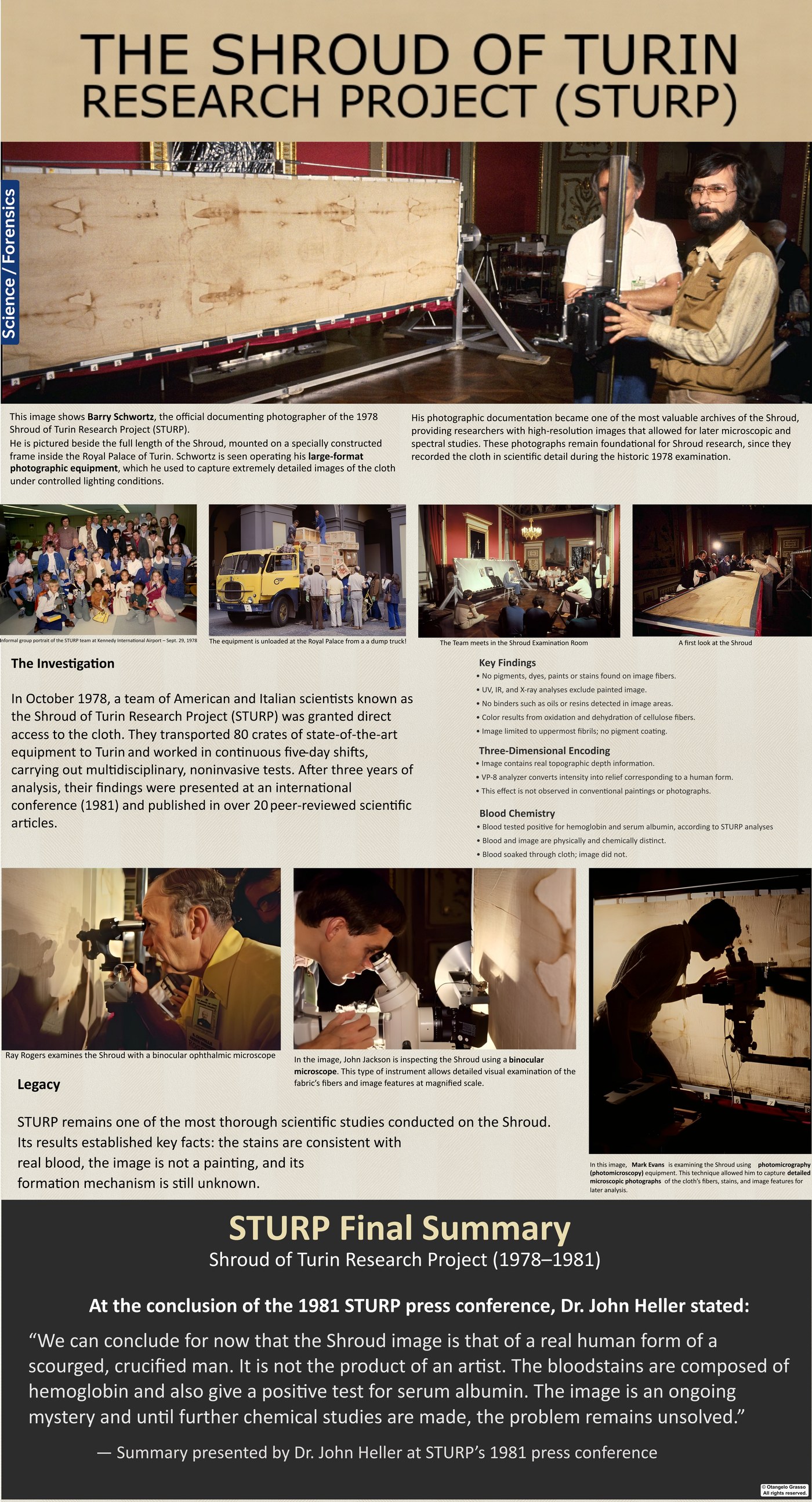
In October 1978 a team of about thirty-three scientists spent 120 hours examining the Shroud in Turin. They used instruments that had never been applied to the cloth before, and they produced the most complete scientific record of the object to that date. Their findings have been debated for four decades, and the team itself was divided on one point. This chapter sets out how the investigation came about, what it established, what it did not explain, and what its members concluded.
The team and the setting
The Shroud of Turin Research Project, known as STURP, was formed in 1978 by a group of American scientists and engineers who had come together at a conference on the cloth in 1977. The members came from national laboratories, universities, and industry. Some were believers, some were sceptics, and several came with no view on the question of authenticity.1
The Turin authorities granted access during the public exhibition of 1978, the first since 1933. The examination took place in the Royal Palace in Turin, beside the cathedral, over about 120 hours. The team brought custom-built instruments and worked in shifts. Before arriving, the team had rehearsed its methods in a dry run at a site in Connecticut, so that the procedures would be ready when the cloth was in front of them.2
The instruments
The team used a range of methods. Photographic work included standard colour, X-radiography, transmitted light, ultraviolet and infrared photography, and photomicroscopy, and it produced one of the most complete imaging records of any textile.2 Spectroscopic methods included ultraviolet-visible, infrared, and X-ray fluorescence analysis. Microscopy was used on fibres and on adhesive-tape samples, which were lifted from the cloth at many points and examined afterward in the laboratory. The team also measured the image’s brightness and mapped it, which gave the first systematic record of the relationship between brightness and the cloth’s surface.
What the investigation established
The team reported that no pigment, dye, or binding medium of a kind used in traditional painting was detected on the image fibres. X-ray fluorescence, infrared reflectance, and microscopy failed to identify an added colouring agent. The image was found to lie on the outermost layer of the fibres, roughly 200 to 600 nanometres deep, and to consist of linen that had been changed by oxidation and dehydration.2
The team also reported that the image’s brightness correlates with the distance between the cloth and the body, in the way described in Chapter 6. The study of the blood, by Heller and Adler and by others, identified heme, protein, and bilirubin, consistent with human blood, and the blood was found to lie beneath the image in the places where they overlap.3 The wounds were described as consistent with a scourging, a crowning, and a crucifixion, in the terms discussed in the earlier chapters.
What the investigation could not explain
The team could not account for the image’s formation. The superficial, non-pigmented, distance-encoded image has no known parallel in painting, photography, or any other technique that the team could test, and the team did not agree on what had produced it. The investigation also left the question of the cloth’s age open. The team did not reach a consensus on the date, and its main published summary does not give one.2
Several of the team’s findings have been contested since. The blood identification has been challenged on the species question, and the uniqueness of the three-dimensional encoding has been debated. The team’s results remain central to the debate, and the interpretations of them vary.
The 1981 consensus statement
In 1981 the team issued a public summary of its conclusions. The statement was cautious. It said that the image is that of a real human form of a scourged, crucified man, and that the image is not the work of an artist. It also said that how the image was produced remained a mystery.4 The statement was reported widely, and some press coverage went further than the statement itself. The chapter gives the wording as published, and it notes that interpretations of the statement vary.
The McCrone dispute
The microscopist Walter McCrone was not a member of the team’s core group, but he examined tape samples from the cloth, which had been collected by the team member Raymond Rogers. He reported particles of iron oxide and vermilion, which he took to be the pigments of a painting, and he concluded that the image and blood marks were paint.5
The majority of the team disagreed. The team’s X-ray fluorescence analysis, which was directed by Morris, Schwalbe, and London, found that iron concentrations were uniform across image and non-image areas. The team argued that this pattern fitted the retting process used to prepare ancient linen, rather than local application of paint. The vermilion particles were present across the whole cloth, including areas without the image, which the team took to show contamination from the environment. No binding medium was found, and no pigment was found adhering to the image fibres in the way that a painting would require.2 McCrone maintained his position, and the dispute was not resolved. The chapter reports both sides, and it notes that the majority view rests on the team’s own analyses.
What the members said
Several members of the team later wrote about their experience. Their views differed. Some said that the investigation had changed their minds about the cloth, and others said that it had left them with a question they could not answer. None of the published summaries claims that the investigation proved the cloth to be from the time of Jesus, or that it proved the identity of the man. The team’s own statements keep the scientific conclusions separate from the questions of identity and faith.
The interface
The team’s work is described by some writers as an interface between the cloth and the instruments, between measurement and interpretation, and between science and the question of who the man was. That description is useful, but the interface has a clear edge. The investigation can say what the cloth is made of and how the image and blood relate to each other. It cannot say how the image was formed, when the cloth was made, or who wrapped the body in it. Those questions are taken up in the remaining chapters.
References
- Shroud of Turin Research Project, membership and history. The team’s formation and its members are discussed in the historical literature. Publication details to be confirmed before publication.
- Schwalbe, L. A., & Rogers, R. N. (1982). Physics and chemistry of the Shroud of Turin: A summary of the 1978 investigation. Analytica Chimica Acta, 135, 3–49.
- Heller, J. H., & Adler, A. D. (1981). A chemical investigation of the Shroud of Turin. Canadian Society of Forensic Science Journal, 14(3), 81–103.
- STURP consensus statement, 1981, as reported in the scientific and popular literature. The wording quoted here is the team’s own, as recorded in the historical sources. Publication details to be confirmed before publication.
- McCrone, W. C. (1990). The Shroud of Turin: Blood or artist’s pigment? Accounts of Chemical Research, 23(3), 77–83.