The Shroud of Turin · Chapter 19 of 21
The radiocarbon date: what the 1988 test found and what has been argued since
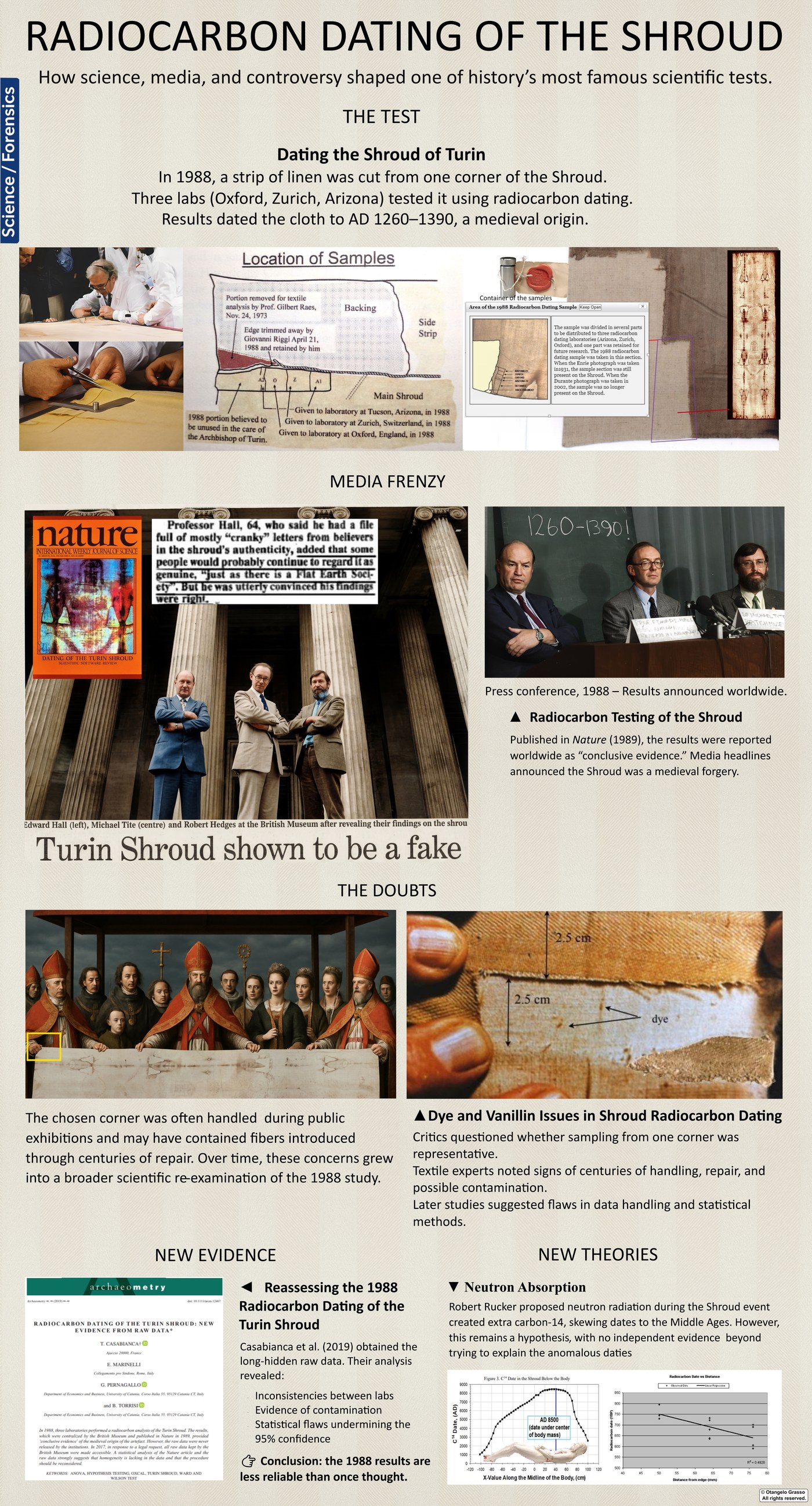
In 1988 three laboratories dated a sample from the Shroud to the period between 1260 and 1390 CE. The result placed the linen in the medieval period, and it has shaped the public debate about the cloth ever since. This chapter sets out the test, the sample, the arguments that the result does not describe the whole cloth, and the chemical and textual objections that have been raised. It also states what the date does and does not establish.
The test
In April 1988 the Archbishop of Turin gave permission for samples to be taken for radiocarbon dating. The samples were cut from one corner of the cloth, close to the side strip, and divided among the three laboratories: the University of Oxford, the University of Arizona, and the Swiss Federal Institute of Technology in Zurich. The samples were prepared and measured by accelerator mass spectrometry.1
The three laboratories reported results that were consistent in outline. Oxford returned an age of about 750 years before present, Arizona about 646, and Zurich about 676. After calibration against the known variation in atmospheric carbon-14, the three results converged on a calendar date range of 1260 to 1390 CE at 95 per cent confidence.1 The results were published in Nature in 1989.
Why the sample matters
Radiocarbon dating rests on three assumptions. The sample must be chemically uniform. Its carbon must have been fixed when the organism was alive and not changed afterward. And the sample must be representative of the object as a whole. The 1988 test relied on all three. The protocol agreed in advance called for seven laboratories, samples from several locations including the main body of the cloth, and a double-blind procedure. What was carried out was narrower. Three laboratories took part, all samples came from one corner of the cloth, and later discussions have noted that the laboratories’ directors knew one of the samples was the Shroud.1
The question of representativeness has been the centre of the dispute. If the corner differs from the rest of the cloth, the date applies to the corner and not to the whole.
Heterogeneity between the subsamples
The three laboratories each measured subsamples, and the subsamples were not identical in their results. In 2017 the French statistician Tristan Casabianca, working from data obtained through freedom-of-information requests to the Arizona and Oxford laboratories, argued that the variation between the subsamples was larger than measurement error would explain.2 He concluded that the assumption of a single uniform age for the sample could not be taken as proven. The argument is valid as far as the statistics go. It does not show by itself that the date is wrong, only that the sample was not demonstrably uniform.
Contamination
The contamination hypothesis holds that a sample can acquire modern carbon from smoke, from handling, or from microbial growth, and that the added carbon makes the sample appear younger. The laboratories used an acid-base-acid pretreatment, designed to remove such contaminants. Some critics argue that the pretreatment is not enough for a cloth with a long history of handling and fire. The fire of 1532 and the water used to put it out are often cited. The contamination argument has force, but it has to be shown that the contamination was large enough and was not removed, and that has not been demonstrated for this sample.3
The invisible reweave
The textile specialist Gilbert Raes proposed that the sampled corner had been repaired with a medieval invisible reweave, so that the sample came from newer material. The proposal has been discussed for decades. The textile expert Mechthild Flury-Lemberg, who examined the reverse of the cloth during its conservation, reported that she found no evidence of such a repair in the sampled area, and she argued that an invisible repair of that kind would be very difficult to make without leaving a trace.4 The reweave hypothesis is not ruled out, but the direct evidence has not supported it.
Chemical differences
The chemist Raymond Rogers, who was a member of the 1978 team, examined threads from the radiocarbon corner and from the main body of the cloth. He reported that the corner material contained vanillin, a degradation product of lignin, which he took to indicate that the corner was younger than the main cloth. He also reported cotton fibres and traces of dye and mordant in the corner, which were absent from his samples of the main body.5 Rogers’s work was published in 2005 after peer review.
These findings have not been replicated with verified samples of known provenance. Other explanations exist for each. Vanillin can form from heat, and the corner was near the 1532 fire. Cotton can come from several sources, and dyes were reported elsewhere on the cloth. The differences are documented by measurement, but their meaning is contested.
What the date establishes
The date establishes the age of the carbon in the sampled material. If the sample was representative and uncontaminated, the linen from which it came was made between about 1260 and 1390. The result is a strong argument for a medieval origin for that material. It is not, on its own, an argument about the rest of the cloth, and the arguments about homogeneity, contamination, and reweaving are all about whether the sample represents the whole.
The date is also in tension with some of the other evidence discussed in this series. The textile evidence, the pollen and mineral traces, and the wounds have been read by some researchers as pointing to an earlier date. Those readings are discussed in their own chapters. The date and the other evidence are different kinds of evidence, and the question of how to weigh them is a judgement, not a calculation.
A balanced summary
Three things are established by the record. The three laboratories gave results that agreed on a medieval date for the sampled material. The subsamples showed more variation than some critics think is acceptable. And the sampled corner has chemical features that differ from the main body of the cloth, though those features have not been independently replicated. What remains open is whether the corner is representative of the whole cloth, and whether a reweave, contamination, or the original cloth is the explanation for the corner’s features.
A further test of the sampled corner, with fresh samples taken under controlled conditions and sealed in a blind protocol, would help to decide the question. The chapters that follow look at the physics of the image and at the forgery question, and each takes the date into account.
References
- Damon, P. E., et al. (1989). Radiocarbon dating of the Shroud of Turin. Nature, 337, 611–615. doi:10.1038/337611a0
- Casabianca, T. (2017 and later). Statistical analysis of the subsample data from the 1988 radiocarbon measurements, using data obtained through freedom-of-information requests. Publication details to be confirmed before publication.
- Contamination and pretreatment in radiocarbon dating, as discussed in the scientific literature on the Shroud. Publication details to be confirmed before publication.
- Flury-Lemberg, M. (1988). Das Turiner Grabtuch und der Ursprung seines Bildes. Bern: Abegg-Stiftung. Her examination of the reverse of the cloth is discussed in the later literature. Publication details to be confirmed.
- Rogers, R. N. (2005). Studies on the radiocarbon sample from the Shroud of Turin. Thermochimica Acta, 425(1–2), 189–194.