The Shroud of Turin · Chapter 20 of 21
The physics of an impossible image: the hypotheses for how the image formed
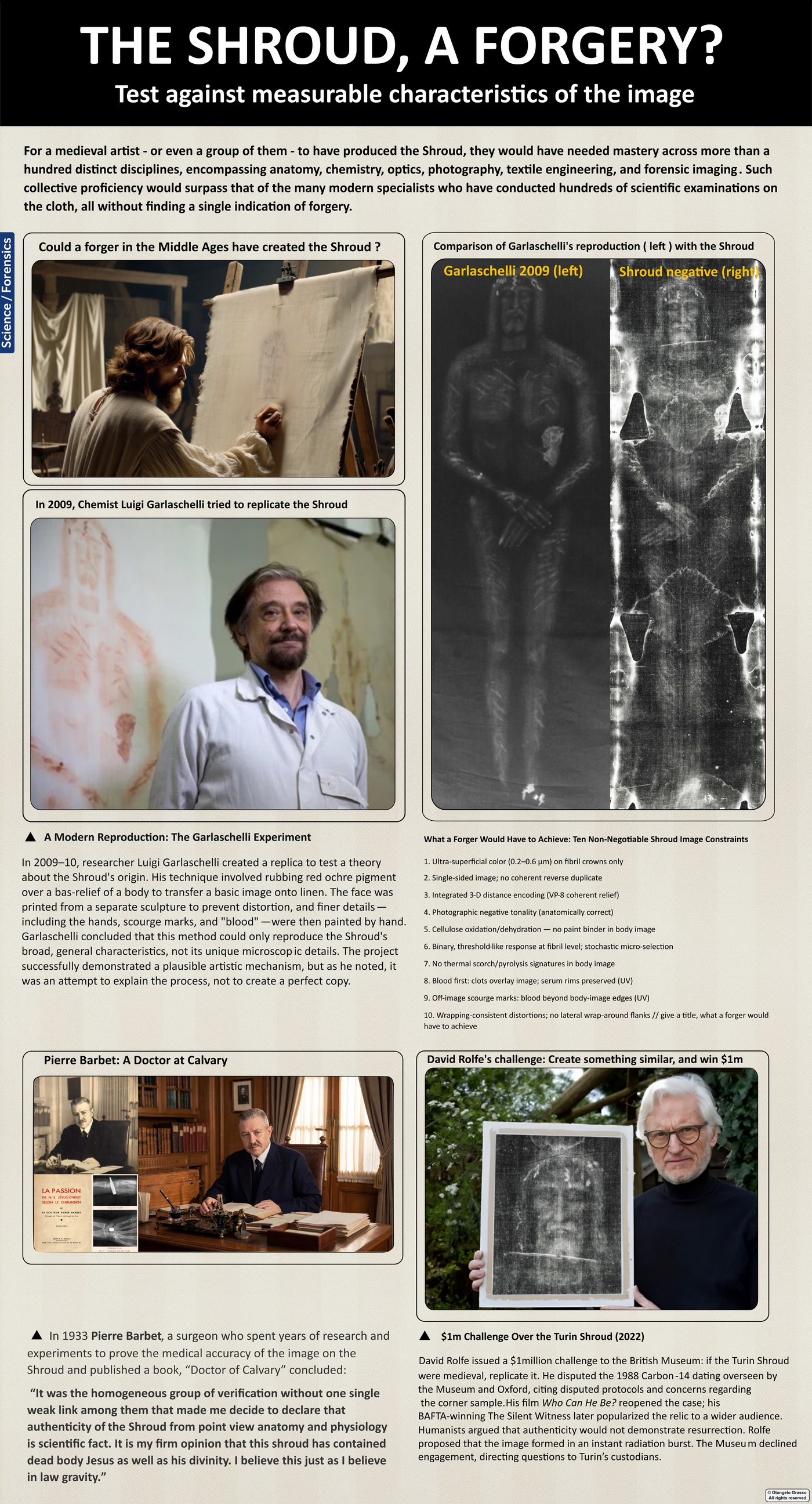
The image on the Shroud is the feature that has most resisted explanation. It is a negative. It lies only on the outermost fibres, about 200 to 600 nanometres deep. It contains no pigment that anyone has found. Its brightness tracks the distance between cloth and body. It stops at the edges of the bloodstains. Any account of how it was made has to satisfy all of these properties at once, and that requirement is what makes the question hard. This chapter sets out the properties, the candidate mechanisms, and the state of the tests.
The properties to be explained
The 1978 investigation and the work since then have fixed a set of properties that any mechanism must reproduce. The image is a negative, so light and dark are reversed relative to a positive body. It is superficial, lying on the outermost layer of the fibres. It has no detectable pigment, dye, or binder. Its brightness relates to distance from the body, in the way described in Chapter 6. It shows no brush marks or directional strokes. It stops at the bloodstains, which were on the cloth first, as Chapter 3 explains. And, at the scale of the full cloth, the image has no halo or lateral smear beyond the body outline.1
These properties are well documented, and the chapter takes them as the starting point. Each property is a constraint, and a mechanism that satisfies some of them but not all has to be treated as incomplete.
Paint
The simplest explanation is that the image was painted. The chemical evidence weighs against it. The 1978 team detected no pigment, dye, or binder in the image fibres, and the image does not sit in the way paint would sit on a fibre.2 A painted negative would also require a concept of photographic negatives that did not exist before the nineteenth century. Walter McCrone argued that the image contains pigment particles, but the majority of the team and later work did not accept that reading, as Chapter 18 explains.3 On the present evidence, paint is not the mechanism.
Contact and bas-relief
A second family of explanations supposes that the cloth was pressed against a body or a sculpted relief. Contact transfer would produce stains where the cloth touched, and it would not reproduce the image in the hollows where the cloth did not touch. Bas-relief transfer has been tested by Joe Nickell and others, and the results show tonal gradients that resemble some of the Shroud’s features, but the transfers encode contact and pressure rather than distance.4 Cicero Moraes argued in 2025 that a low-relief contact model fits the contour of the image better than a full body, and critics replied that the study ignored the chemistry and the dorsal image.5 Contact mechanisms therefore account for some of the geometry but not for the chemistry or for the image in the non-contact areas.
Scorch and heat
Scorching, which colours linen by heat, produces a coloured layer that penetrates further into the fibre and shows a gradient with heat. The image is not scorched in this sense. The 1532 fire scorched the cloth, and the scorch marks look different from the body image. This is a strong argument against heat as the mechanism for the body image.2
Vapour and corona
Proposals that a vapour or a gas acted on the cloth have been made since the 1940s. The French researcher Jean Volckringer argued that pressed plant specimens could record contact images over long periods, through slow diffusion, and that a similar process might have formed the Shroud image.6 Later researchers examined the chemistry of amine and sugar reactions under extended low-temperature exposure. Corona discharge has been proposed by Giulio Fanti and Roberto Basso, who argued that an electrical discharge could colour the outer fibrils.7 These proposals address the superficiality and the lack of pigment. They have not been shown to produce the full set of properties, and the tests of them are still incomplete.
Radiation
The most developed family of proposals holds that radiation, rather than contact or heat, coloured the outermost layer of the fibres. Radiation travels in straight lines, which fits the lack of lateral smear. Its intensity falls with distance, which fits the relationship to the body. At suitable wavelengths it acts on the outermost molecular layer, which fits the superficiality.8
An Italian team at the ENEA research centre at Frascati, led by Paolo Di Lazzaro, reported in 2010 experiments in which pulses from a deep ultraviolet excimer laser coloured linen samples in a way that resembled the Shroud’s coloration, with a sharp energy threshold.8 The experiments are important because they show that a physical process can produce coloration of this kind on a sample. They are not a reproduction of the full cloth. The samples were small, the exposures were controlled, and the experiments did not show the distance encoding over a full body-sized surface.
A proposed deep ultraviolet framework
Building on the ENEA work, Otangelo Grasso has proposed a two-phase framework in which blood is deposited by contact first, and the image forms afterward by a short, near-threshold exposure to deep ultraviolet pulses whose intensity depends on distance. The framework is designed to satisfy all the constraints listed above.9 It is a proposal, and it has not been independently tested or peer reviewed. Its tests are described below.
What the tests would need
A radiation hypothesis can be tested, and the tests are demanding. A known relief under taut linen could be exposed at near-threshold intensities, and the resulting image could be measured for its relationship to distance. The result would need to show a close fit to the Shroud’s brightness relationship, without lateral smear. The coloured layer would need to be measured at the scale of the fibrils, by transmission electron microscopy and atomic force microscopy, to confirm the penetration depth. The chemical changes would need to match the Shroud’s, and the blood would need to be shown to survive the exposure unchanged.
No experiment has yet met all of these requirements at full scale. The gap between a laboratory result on a small sample and a full-cloth image is the main difficulty for every radiation hypothesis, and it is a gap that has not been closed.
What is established and what is not
Several things are established with reasonable confidence. The image is not paint, and no pigment has been identified in its fibres. It is a chemical change in the outermost layer of the linen, and it carries distance information in the relationship to brightness. It is not a stain of blood or a simple scorch. The blood was on the cloth before the image formed. Each of these points is supported by the 1978 work and later analyses.
Other things are not established. The mechanism of formation is not known. No candidate has been shown to produce all the properties at full scale. The radiation hypotheses are promising but untested at the scale needed. The claim that the image could not have been formed by any known process is stronger than the evidence allows: the image has not been reproduced, and the absence of a reproduction is not proof that no natural process could have formed it. Equally, the claim that a particular process formed it has not been demonstrated.
The chapter does not claim that the image is supernatural, nor that it is a medieval product. The image’s formation is an open scientific problem, and the honest position is to say so.
What comes next
The formation question is separate from the date and from the forgery question, which are discussed in the next chapters. A mechanism that formed the image would still have to be consistent with the date of the linen, and a forgery hypothesis would still have to explain the image. The last chapter takes up the forgery question as a whole.
References
- Schwalbe, L. A., & Rogers, R. N. (1982). Physics and chemistry of the Shroud of Turin: A summary of the 1978 investigation. Analytica Chimica Acta, 135, 3–49.
- Schwalbe & Rogers (1982), op. cit., and Heller, J. H., & Adler, A. D. (1981). A chemical investigation of the Shroud of Turin. Canadian Society of Forensic Science Journal, 14(3), 81–103.
- McCrone, W. C. (1990). The Shroud of Turin: Blood or artist’s pigment? Accounts of Chemical Research, 23(3), 77–83.
- Nickell, J. (1983). Inquest on the Shroud of Turin. Buffalo: Prometheus Books.
- Moraes, C. (2025/2026). Image formation on the Holy Shroud: a digital 3D approach. Archaeometry, 68(1), 84–93. doi:10.1111/arcm.70030 Casabianca, T., Marinelli, E., & Piana, A. (2026). Commentary. doi:10.1111/arcm.70109
- Volckringer, J. (1940s). Work on vaporography and contact images from pressed plant specimens. Publication details to be confirmed before publication.
- Fanti, G., & Basso, R. (2008). Body image formation hypotheses based on corona discharge. Presented at the 3rd Dallas International Conference. Publication details to be confirmed.
- Di Lazzaro, P., and colleagues, ENEA, Frascati (2010). Ultraviolet laser experiments on linen cellulose. Publication details to be confirmed before publication.
- Grasso, O. (2025). Deep ultraviolet photochemical hypothesis for the Shroud image. Self-published framework, not peer reviewed.