The Shroud of Turin · Chapter 21 of 21
The forgery question: what a medieval maker would have needed
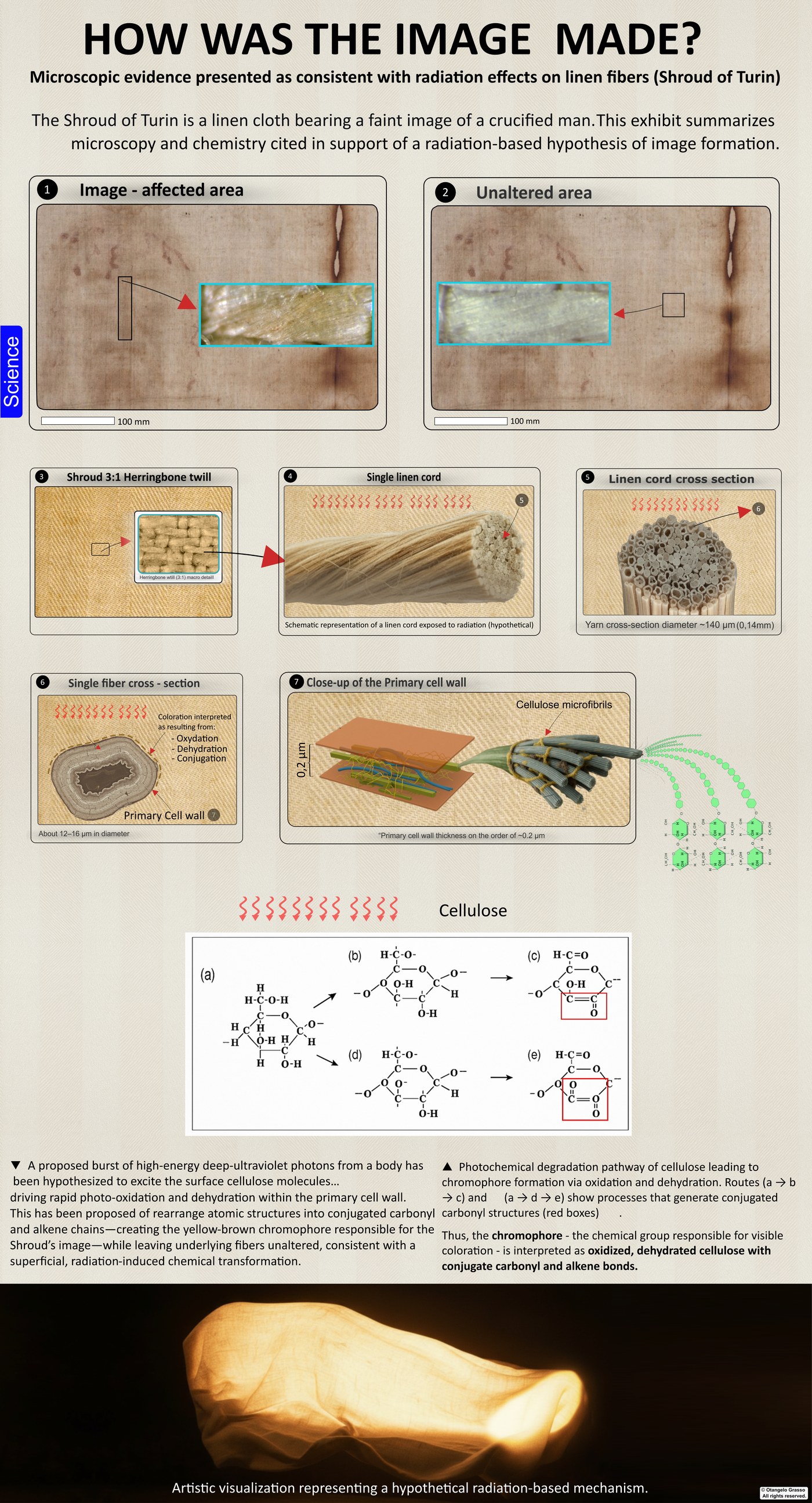
The forgery question is the one most people ask about the Shroud. If the cloth was made in the Middle Ages, who made it, how, and why? If it was made in the first century, why has it survived so long, and how did its image form? The question has two sides. A forgery hypothesis has to explain the evidence, and the evidence has to be read fairly, including the parts that favour the hypothesis. This final chapter sets out the main forgery hypotheses, the arguments on each side, and the limits of the argument from improbability.
The forgery hypothesis in its simplest form
The simplest forgery hypothesis is that a medieval craftsman made the cloth, painted or otherwise marked it, and presented it as a relic. The Lirey record from the 1350s fits this picture. A relic that drew pilgrims and their money had a motive, and the record shows that the exhibitions at Lirey were disputed from the start, as Chapter 16 describes.1
The memorandum of Bishop Pierre d’Arcis, written around 1389, claimed that an artist had confessed to painting the cloth. That claim, if it were reliable, would settle the matter for the Lirey cloth. As Chapter 5 explains, the memorandum has a complicated history, its editing is disputed, and no contemporary record of the confession survives.2
The argument from knowledge
A common argument is that the forger would have needed knowledge that did not exist in his time. He would have needed to know that a crucifixion nail should go through the wrist, that a flagrum makes paired wounds, that blood separates into clot and serum, and that the image should be a negative and distance-encoded. Each of those is a point made in earlier chapters.3
The argument is strong if it is stated carefully. A forger does not need to understand a mechanism in order to copy an appearance, and an artist who had seen a real wound, or an earlier relic, could reproduce a feature without knowing its cause. The fair question is therefore not whether a medieval person had a modern theory, but whether any known medieval process could produce the full set of features. The argument from knowledge is an argument about the complete pathway, not about the maker’s textbook learning.
The technology argument
A second argument is about technique. The image is superficial, its colour lies on the outermost fibrils, and its brightness tracks distance. A painter working by hand could not produce those properties, and no medieval process is known that could. The argument depends on the same premise as Chapter 20: that no known process reproduces the image. It is a strong argument for the claim that the image was not made by ordinary painting. It is weaker as an argument about all possible medieval methods, because the mechanism is not known.
Painting and the chemical evidence
The painting hypothesis is the most direct test, and the chemical evidence weighs against it. No pigment or binder was found in the image fibres by the 1978 team, and the image does not sit on the fibres in the way paint does.4 McCrone’s contrary reading, based on pigment particles in tape samples, did not win the support of the majority of the team, as Chapter 18 explains.5 On the present evidence, a painted forgery is not supported by the chemistry of the image.
The bas-relief hypothesis
A more sophisticated hypothesis is that the cloth was pressed against a sculpted relief, which would produce a tonal image with some of the Shroud’s geometry. Joe Nickell tested this in 1983, and the transfers he produced showed gradients that resemble parts of the Shroud.6 Critics respond that contact records pressure, not distance, and that a bas-relief cannot produce image in areas it never touched, such as the hollows of the eyes. Cicero Moraes argued in 2025 that a low-relief model fits the contour better than a full body. His critics answered that the study does not address the chemistry or the dorsal image, and the exchange is still open.7
The proto-photography hypothesis
A more unusual hypothesis is that the image was made by a medieval process resembling photography. It has been proposed that a camera obscura, or a light-sensitive chemical applied to the cloth, could have produced a negative. The proposal has been made in the art-historical and popular literature, and it has been promoted by some writers in biblical studies.8 It explains the negative character, but it has to explain the superficiality, the lack of any chemical residue, and the distance encoding. The chemistry of the image does not match the reagents such a process would leave, and the hypothesis has not been tested in a form that reproduces the full set of properties.
The radiocarbon date
The radiocarbon date of 1260 to 1390 is the central test of the medieval hypothesis. If the sample is representative, the linen is medieval, and the forgery question is largely settled in favour of a medieval origin for the cloth. Chapter 19 sets out why the sample’s representativeness has been disputed. The heterogeneity of the subsamples, the chemical differences of the sampled corner, the reweave hypothesis, and the contamination argument are all live questions, and none has been decided.
The Nicolotti thesis
The most sustained scholarly case for a medieval origin has been made by the historian Andrea Nicolotti. His work on the Mandylion and on the Shroud’s documentary history argues that the record before 1355 contains no credible evidence for the cloth, that the radiocarbon date is reliable, and that the scientific arguments for authenticity have been overstated.9 His historical scrutiny of hagiographic claims is widely respected.
Critics of Nicolotti argue that the radiocarbon date is not secure enough to carry the weight he places on it, that his reading of the documents depends on the argument from silence, and that some of the scientific evidence he sets aside is not easily dismissed. The disagreement is substantive, and it is conducted in the scholarly literature. A fair reading of the debate gives weight to both sides. The historical argument is strongest where it is documentary, and the scientific argument is strongest where it is measured.
The argument from improbability
The series has presented several features that would be difficult for a medieval forger: the wrist wounds, the absent thumbs, the flagrum pattern, the blood before the image, the negative character, and the distance encoding. Each is improbable taken alone for a medieval maker. Several are also improbable taken together.
The argument from improbability has limits. Improbability is not impossibility. A count of features that match a hypothesis depends on which features are counted, and a list of improbable features can be assembled for almost any object. The argument is strongest when each feature is measured, the set of features is defined in advance, and the comparison is made against a fair alternative. It is weaker when the features are chosen after the fact. For this reason the series has tried to separate the measured features from the interpretations, and it has treated the forgery question as open.
What the evidence decides and what it does not
The evidence supports some conclusions with reasonable confidence. The image is not paint. The blood was on the cloth before the image formed. The image encodes distance in a systematic way. The wounds are consistent with a scourging and a crucifixion, and the blood and wound features are consistent with the Gospel sequence.
The evidence does not decide the date of the linen with certainty, because the radiocarbon sample is disputed. It does not decide the mechanism of the image. It does not decide who made the cloth, or whether anyone made it. And it does not decide the identity of the man. Those questions remain open, and the series has said so at each step.
A closing note
The series has examined the cloth from several directions: its linen and blood, its history, its image, and the arguments about its date and origin. Each direction has produced evidence and questions, and no single line of evidence closes the case. The reader is invited to weigh the evidence, to read the sources, and to reach a view of the question. The honest position is that the Shroud is a physical object with a documented history and an unexplained image, and that the question of its origin is still a question.
References
- Wilson, I. (1978). The Turin Shroud. London: Victor Gollancz. The Lirey record and the early exhibitions are discussed in the historical literature.
- d’Arcis, P. (c. 1389). Memorandum, edited by Chevalier, U. (1900). Étude critique sur l’origine du Saint-Suaire de Lirey–Chambéry–Turin. Paris.
- Barbet, P. (1953). A Doctor at Calvary. New York: P. J. Kenedy & Sons. Zugibe, F. T. (2005). The Crucifixion of Jesus: A Forensic Inquiry. New York: M. Evans and Company.
- Schwalbe, L. A., & Rogers, R. N. (1982). Physics and chemistry of the Shroud of Turin: A summary of the 1978 investigation. Analytica Chimica Acta, 135, 3–49.
- McCrone, W. C. (1990). The Shroud of Turin: Blood or artist’s pigment? Accounts of Chemical Research, 23(3), 77–83.
- Nickell, J. (1983). Inquest on the Shroud of Turin. Buffalo: Prometheus Books.
- Moraes, C. (2025/2026). Image formation on the Holy Shroud: a digital 3D approach. Archaeometry, 68(1), 84–93. doi:10.1111/arcm.70030 Casabianca, T., Marinelli, E., & Piana, A. (2026). Commentary. doi:10.1111/arcm.70109
- Allen, N. (1993) and Tabor, J. on the proto-photography hypothesis. Publication details to be confirmed before publication.
- Nicolotti, A. (2020). From the Mandylion of Edessa to the Shroud of Turin. Publication details to be confirmed before publication.