The Shroud of Turin · Chapter 6 of 21
When distance became data: the three-dimensional encoding
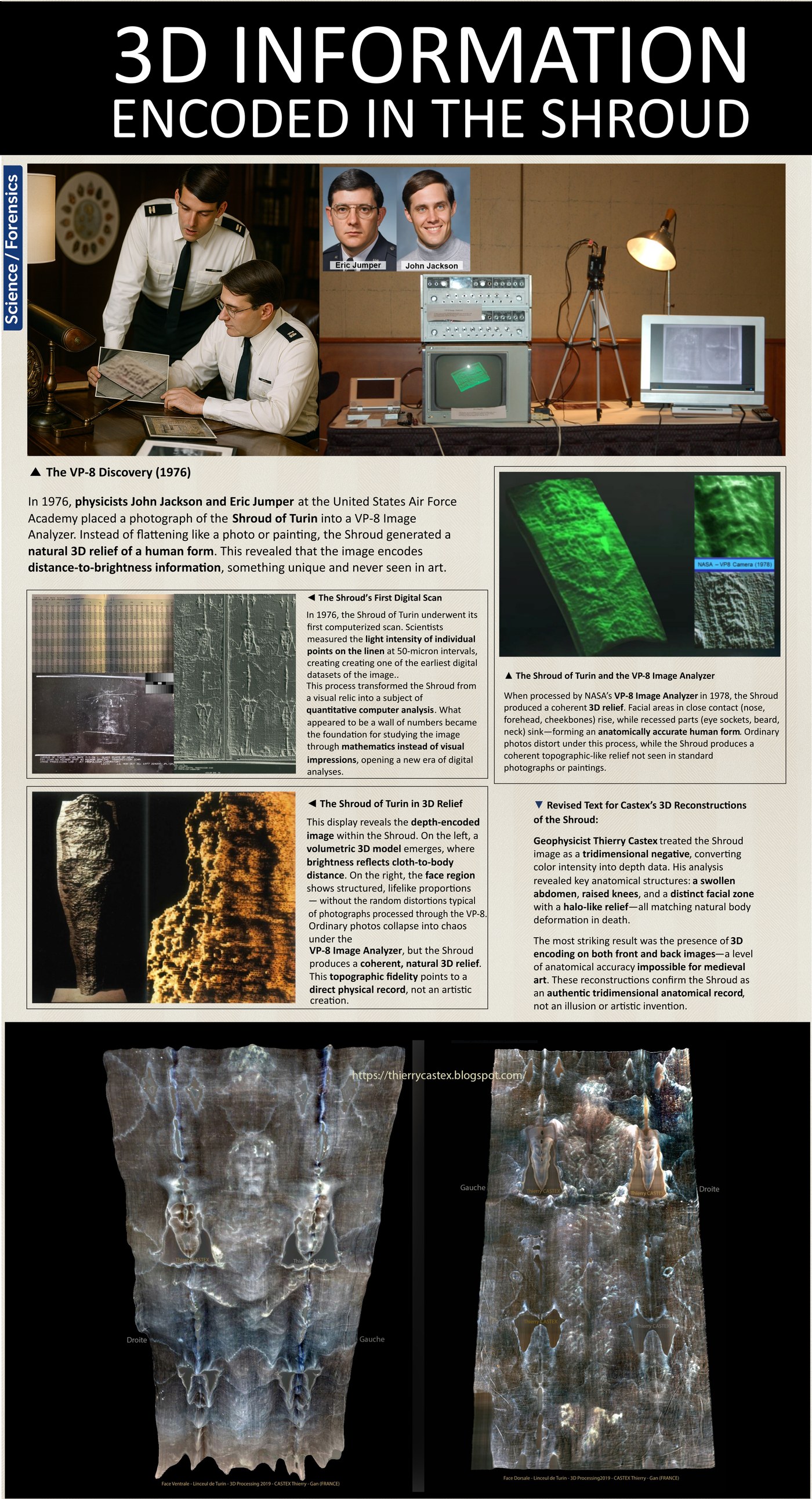
A photograph records how much light reaches the film from each part of a scene. On the Shroud, the brightness of the image appears to track something else: how far each point of the cloth was from the body beneath it. When that relationship is read as data, a three-dimensional relief of the figure emerges.
This chapter explains how that relationship was found, what the analysis showed, how it has been checked since, and where the claims are still open. It is the subject of a large body of technical work, and the key numbers come from a small number of publications that should be read in full.
The first analysis, 1976
In February 1976, the physicist John Jackson and the Air Force officer Eric Jumper took a photographic negative of the Shroud to the VP-8 Image Analyzer, a machine developed for processing aerial and satellite images. The VP-8 reads brightness as elevation. Given a normal photograph, it produces a confusing topographic map, because the brightness in a photograph reflects lighting and not shape. Given the Shroud, the machine produced a coherent human face, with the nose in relief and the eye sockets receding.1
The VP-8 operator, Pete Schumacher, later described the result as unlike anything he had processed through the machine before or since.1 The observation prompted a more careful test, which Jackson carried out before the VP-8 session.
The correlation with distance
Jackson’s question was whether the darkness of the image at a point tracks the distance between the cloth and the body at that point. He chose a set of anatomical locations on the face where the distance could be estimated by assuming the cloth draped naturally over a human form. He measured the optical density of the image at each point, and he compared the densities with the estimated distances.2
If darkness and distance were unrelated, the points would scatter, and the correlation would be close to zero. If darkness reliably tracked distance, the points would cluster, and the correlation would approach one. The early analysis reported a correlation of about 0.6 across the chosen points, a moderate positive correlation in the sampled points; it does not by itself identify the image-forming process.2
The 1984 study by Jackson, Jumper, and William Ercoline extended this work. The authors digitised high-resolution photographs of the cloth, measured the density at many points, built a model of a human body, and calculated the distance from each body point to a draped cloth. They then tested the relationship against randomised versions of the data, and reported that the correlation was not explained by chance.3 They presented their conclusion carefully: the image intensity at each point is related to the cloth-to-body distance at that point, a property they did not find in the photographs, paintings, or drawings they examined.3
What a distance relationship means
An ordinary photograph encodes lighting. A painting encodes the choices of the artist. Neither encodes a physical distance in the way that the Shroud appears to. The relationship found in 1984 resembles what a process would produce if its intensity fell off with distance from the surface, the way light and radiation do. That is a description of the pattern, not an explanation of the process that made it.3
The authors reported that measured image intensity correlated with their estimated body-to-cloth distances. This supports a distance-related description; it does not establish that creases or weave never affect intensity.3
Checking the claim
Several objections deserve a direct answer.
- The lighting objection. A photograph of a relief can also produce a distance-like pattern, because lighting and shape are linked. Tests of this kind help to separate the two, and the Shroud’s pattern has been compared with such tests in the literature.
- The bas-relief objection. The skeptical investigator Joe Nickell showed in 1983 that a cloth pressed against a bas-relief can take on tonal gradients that the VP-8 renders as relief. Critics argue that such transfers record contact and pressure rather than distance, and that they fail where the Shroud keeps its information, such as the nose and the orbital ridges.4
- The draping objection. The image shows distortions at the hands and the calves that match a cloth draped over a three-dimensional body. Those distortions have been cited as evidence of draping. A recent study published in Archaeometry argued that the image is closer to a bas-relief imprint than to a draped body.5 The debate is open, and the 3D reconstructions depend on the assumptions made in building them.
- The collapse model. A cloth collapsing into the space of a body should produce lateral distortion at the sides of the figure. Jackson and Jumper proposed a model in which the image forms by projection, which would suppress lateral distortion. Critics note that the model and the observation support each other, and that an independent test of collapse geometry has not yet been designed.3
The surface of the linen
Some ultraviolet-laser experiments produced shallow coloration in linen fibres, but laboratory results do not establish the thickness or formation process of the Shroud image.6 The chemist Heller and Adler reported that the image is not a stain of blood or pigment, and that the body image is consistent with oxidation of the linen cellulose.7
The image is not formed evenly on each fibre. Some reports describe the coloured fibrils as either coloured or not, and the continuous tones as the result of how many fibrils are coloured in an area, much as a halftone print builds grey from dots. That description is a model of the surface, and it has been proposed in several forms. It is not a settled fact.
Later work
The analysis has been repeated with newer instruments. In the 2000s, the Dutch physician Petrus Soons used enhanced versions of Enrie’s 1931 photographs to produce depth data and holographic reconstructions of the face. Those reconstructions show more detail than the VP-8 did, and they are a useful visual record. They are also interpretations of processed images, and they depend on the enhancement methods used.
Thierry Castex has produced three-dimensional renderings of the image using filtering and height conversion. His rendering of the dorsal image shows less relief than the front, with distortion where the scourge marks interfere with the conversion. Renderings of this kind help to show structure. They do not measure the body, and their output depends on the processing chosen.
The 1988 radiocarbon result placed the linen in the medieval period. The three-dimensional encoding was measured on the image itself, and the two findings are separate questions, to be weighed in the chapters on the radiocarbon result and on the image.8
Some proposals try to explain how the image could be formed by a short burst of ultraviolet radiation. Experimental work with laser ultraviolet sources has produced cellulose colouration with some similar features, including a sharp threshold, but it has not reproduced the full cloth.9 The gap between laboratory experiments and a full-scale cloth is large, and the proposal remains a hypothesis.
The distance-related pattern is a notable result reported in the image analyses. Its reproducibility across methods and investigators, and what it means, remain separate questions. The measurement does not identify the process that formed the image, and it does not say who the man was.
What remains open
Several things remain unresolved. The process that formed the image is not known, and the candidate mechanisms have not been reproduced at full scale. The 1984 study reported a relationship between image intensity and estimated distance; the exact projection geometry and independent reproducibility remain open questions. Three-dimensional renderings depend on processing choices and on the assumptions of the model. Some interpretations of the 3D data rest on tests that have not been repeated independently.
Those limits do not weaken the central measurement. They define the questions the next chapters take up: how the image relates to the cloth, what the blood and the wounds record, and how the image formed.
References
- Schumacher, P. M. (1999). Photogrammetric responses from the Shroud of Turin. Paper presented at the Shroud of Turin International Research Conference, Richmond, Virginia, June 18–20, 1999. https://www.shroud.com/pdfs/schumchr.pdf. Schumacher’s description of the VP-8 result is his own retrospective account.
- Jackson, J. P., Jumper, E. J., Mottern, R. W., & Stevenson, K. E. (1977). The three-dimensional image on Jesus’ burial cloth. In Proceedings of the 1977 United States Conference of Research on the Shroud of Turin, Albuquerque, New Mexico. Full proceedings
- Jackson, J. P., Jumper, E. J., & Ercoline, W. R. (1984). Correlation of image intensity on the Turin Shroud with the 3-D structure of a human body shape. Applied Optics, 23(14), 2244–2270. doi:10.1364/AO.23.002244
- Nickell, J. (1983). Inquest on the Shroud of Turin. Buffalo: Prometheus Books.
- Moraes, C. (2026). Image formation on the Holy Shroud—A digital 3D approach. Archaeometry, 68(1), 84–93. doi:10.1111/arcm.70030
Casabianca, T., Marinelli, E., & Piana, A. (2026). Commentary on the article “Image Formation on the Holy Shroud—A Digital 3D Approach” by Cicero Moraes. Archaeometry, 68(4), 861–863. doi:10.1111/arcm.70109 - Fanti, G., & Maggiolo, R. (2004). The double superficiality of the frontal image of the Turin Shroud. Journal of Optics A: Pure and Applied Optics, 6(6), 491–503. doi:10.1088/1464-4258/6/6/001
- Heller, J. H., & Adler, A. D. (1981). A chemical investigation of the Shroud of Turin. Canadian Society of Forensic Science Journal, 14(3), 81–103.
- Damon, P. E., et al. (1989). Radiocarbon dating of the Shroud of Turin. Nature, 337, 611–615.
- Baldacchini, G., Di Lazzaro, P., Murra, D., & Fanti, G. (2008). Coloring linens with excimer lasers to simulate the body image of the Turin Shroud. Applied Optics, 47(9), 1278–1285. doi:10.1364/AO.47.001278
Di Lazzaro, P., et al. (2010). Deep ultraviolet radiation simulates the Turin Shroud image. Journal of Imaging Science and Technology, 54(4), 040302. doi:10.2352/J.ImagingSci.Technol.2010.54.4.040302