The Shroud of Turin · Chapter 5 of 21
The night the Shroud spoke: Secondo Pia’s photograph
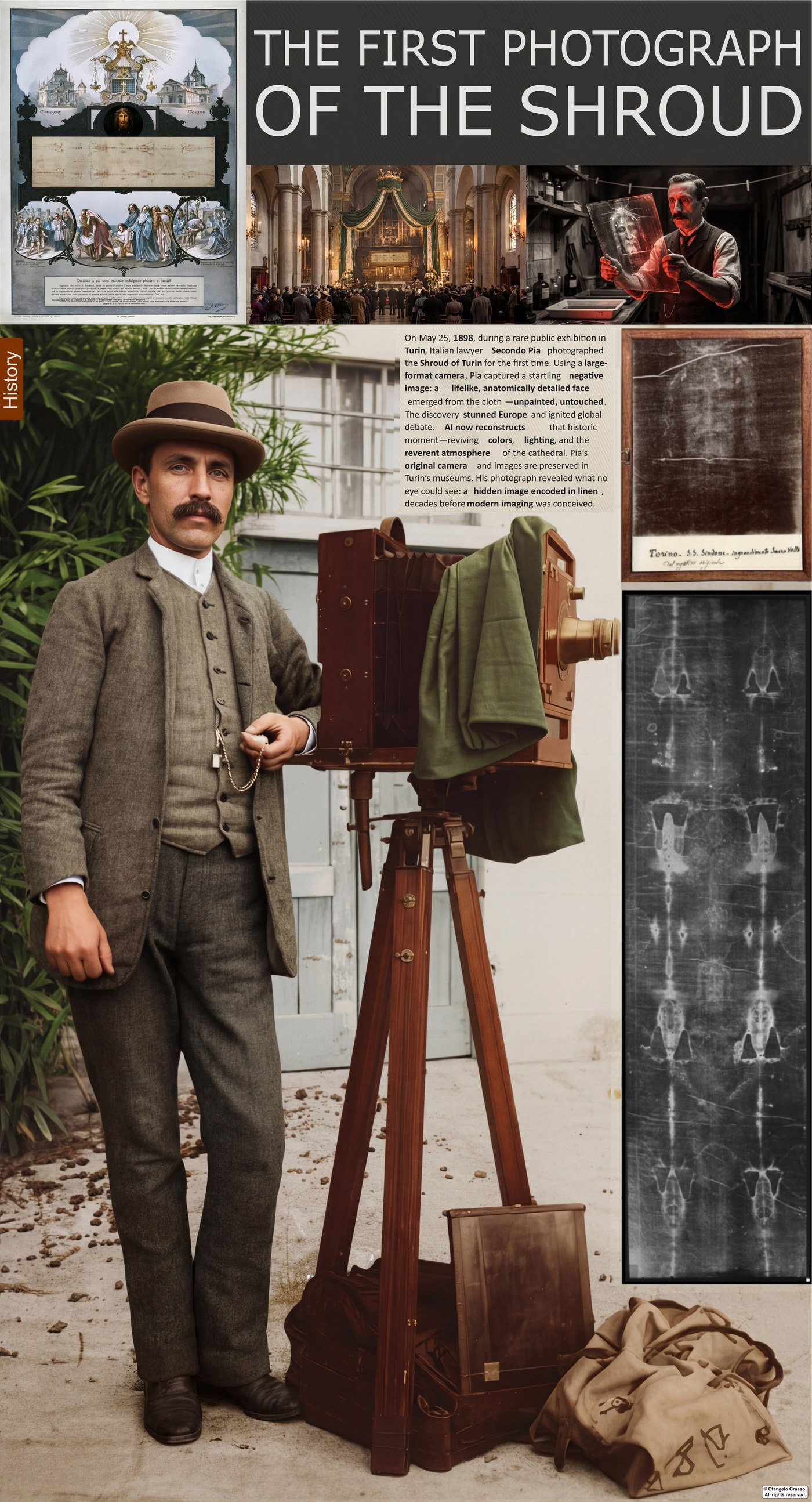
In May 1898, a lawyer from Asti and amateur photographer named Secondo Pia photographed the Shroud of Turin on glass plates. When the plates were developed, the face on the cloth appeared as a positive image. The image on the linen is a negative, and it had not been known before that night.
The photographs brought renewed public and scholarly attention to the cloth and made its image available for detailed photographic study. They did not, by themselves, determine how the image formed or establish the cloth’s age. This chapter covers the setting in which the photographs were taken, what the plates showed, how the press and the scholars responded, and how the discovery was confirmed decades later.
The photographs
Pia took his photographs during a public exhibition of the Shroud in Turin in 1898, held to mark the fiftieth anniversary of the Albertine Statute and to coincide with the city’s celebrations. The cloth was displayed above the high altar of the cathedral, behind a sheet of protective glass. Pia had to work where it hung. He could not take it down or move it outdoors.1
The conditions were difficult. The cloth measures about 4.37 metres by 1.10 metres, and the camera had to be placed on a platform near the altar. The glass caused reflections, the lighting came from electric arc lamps, and the plates needed long exposures, running to several minutes each. Any movement during an exposure would blur the image. Pia used large glass plates, around 50 by 60 centimetres.1
The first attempt, on 25 May 1898, was ruined when the lamps failed. Pia made two exposures before the equipment stopped, and both were flawed. When he developed them, he saw a faint hint of a face in the negatives. He did not announce it, and he went back to make another attempt.1
On 28 May he made the exposures that matter. Several plates were taken, with exposures of a few minutes each, and some were witnessed by others present in the cathedral. He developed them that night. The published accounts agree that the negative of the cloth showed a face that the positive view of the cloth did not.1
What the negative showed
On the cloth, the body image is faint and yellowed, and the face is hard to make out without stepping back. In Pia’s negative the tones were reversed, and the face appeared as a positive portrait with clear features: a nose and a bridge, cheekbones, closed eyelids, and a beard. The image had depth. Its shading is consistent with the form of a face rather than with a flat drawing.1
The negative also showed that the bloodstains behave differently from the body image. The stains appear dark red to brown on the cloth and show as light in the negative. They are a separate layer, which points to a different process in their formation.4
Accounts of that night say Pia reacted with astonishment. A later account attributes to him a remark on seeing the plate, roughly that it was a miracle. The remark comes from later retellings, not from a record made at the time, so it should be read with that in mind.
Why the image is a negative has been a question since that night. Pia had no name for the phenomenon. Photography was new in 1898, and no known pre-modern art form produced a tonal reversal of this kind. Some have argued that a medieval forger could not have conceived of such an image, while others point to metalwork and relief printing, which involve similar tonal reversal. The second argument does not explain how an image of this detail and consistency would have been made.4
Scandal and skepticism
The results were not kept private for long. Within days, newspapers in Italy, France, Germany, and elsewhere reported on the photographs, and some of the press coverage described the face in awed terms. An early Italian report described the plates as showing a naked body lying stretched out, with the marks of the Passion.4
The reaction was not only admiring. Some critics proposed technical explanations, such as the yellow filter Pia used, overexposure, or optical distortion from the glass. Others suggested that Pia had retouched the plates or staged the discovery. The accusation of fraud was hard to disprove at the time, because few people understood the photographic process well enough to assess the plates.4
The most serious challenge came from the French historian Ulysse Chevalier, who in 1900 published an edition of a memorandum by Pierre d’Arcis, Bishop of Troyes. The memorandum claims that an earlier bishop, Henri de Poitiers, had found the cloth to be a painting and that the artist had confessed. Chevalier presented the memorandum as proof that the Shroud was painted.2
The memorandum has a complicated history. The surviving text is unsigned and undated, and some scholars argue that it is a draft of a letter sent to the pope, with a date that fits its references. Critics, including the historian Markwardt, have argued that Chevalier combined two documents and added a date and an address that were not in the original. That charge is disputed.2 The named-artist claim also has a gap. A confession and a forgery finding would ordinarily leave administrative records, and none survive from the mid-fourteenth century. The historian Herbert Thurston, who was no supporter of authenticity, noted this absence.2
For about three decades, the view that the Shroud was a medieval painting, and that Pia’s negative was an accident or a hoax, held wide support. Pia had been right about what he saw, but he could not prove it to a skeptical audience with the plates and his testimony alone.
The 1902 study and the scientists
The discovery was taken up by scientists. The French zoologist Yves Delage, who was agnostic, showed Pia’s photographs to his assistant, the biologist Paul Vignon. Over the next few years Vignon and Delage studied the plates with other specialists. In 1902 Delage presented their argument to the French Academy of Sciences: that the anatomical detail was consistent with a crucified man, and that it was unlikely to be the work of a medieval artist. He said that the identity of that man was a question of history and faith, outside the scope of his scientific argument.3
Delage and Vignon’s work is the first serious scientific study of the Shroud. It set a pattern that later studies would follow, in which the image is read as physical evidence and its interpretation is kept separate from the question of who the man was.
Confirmation in 1931
In 1931 the House of Savoy displayed the Shroud again, this time in Turin, to mark the wedding of Crown Prince Umberto to Princess Marie-José. The exhibition drew large crowds, and the royal family commissioned the photographer Giuseppe Enrie to settle the question that Pia had raised. Enrie was a professional photographer and head of a major studio in Turin.5
Enrie photographed the Shroud on the night of 3 May 1931, with the glass barrier removed. He took a series of photographs, including the full cloth, the dorsal image, the face at larger scales, and a close view of the nail wound in the left wrist. He developed the plates in a darkroom in the cathedral’s sacristy, in front of witnesses. Pia himself was among them, at the age of seventy-five. The plates showed the same negative image that Pia had recorded thirty-three years before.5
The 1931 photographs were technically superior to Pia’s, with better optics and emulsions and no glass between lens and cloth. They provided a later photographic record using different equipment. This was a useful comparison with Pia’s plates, although it was not a modern controlled replication or an independent test of the image’s origin of Pia’s result.5
Why the photograph still matters
Every later study of the image starts from the 1898 negative. Medical and forensic work on the wounds, the three-dimensional analysis discussed in a later chapter, and the physics of the image all depend on the photographic record that Pia made. The negative is also the reason the image has been treated as a possible object of scientific inquiry rather than only a religious relic.
The negative does not settle the question of authenticity. The 1978 STURP investigation found that the body image is an extremely superficial discoloration of the linen fibres, not a painted layer, and the image’s formation remains unexplained.6 The chemist Walter McCrone argued that the image was painted with pigments, a view that most STURP scientists did not accept.7
The 1988 radiocarbon test dated the linen to the medieval period, and the challenges to that result are discussed in a later chapter.8 The photograph does not answer that question. What it does show is that the image has a structure that is difficult to explain under a simple medieval attribution. As the art historian Thomas de Wesselow has put it, the negative is central to the case for the image’s strangeness.9
Secondo Pia died in 1941, a few days before his eighty-sixth birthday. He lived long enough to see Enrie’s 1931 photographs confirm his own.
References
- Zaccone, G. M. (ed.) (1998). L’immagine rivelata. 1898: Secondo Pia fotografa la Sindone. Turin: Centro Studi Piemontesi. Exhibition catalogue, 194 pp. Cataloguing institution.
- Chevalier, U. (1900). Étude critique sur l’origine du St Suaire de Lirey–Chambéry–Turin. Paris: A. Picard. Bibliothèque nationale de France catalogue. See also Poulle, E. (2006), “Le linceul de Turin victime d’Ulysse Chevalier,” Revue d’histoire de l’Église de France, 92(229), 343–358, doi:10.1484/J.RHEF.2.304979.
- Vignon, P. (1902). Sur la formation d’images négatives par l’action de certaines vapeurs. Comptes rendus de l’Académie des sciences, 134, 902–904 (note presented by Yves Delage). Delage’s separate discussion appeared as “Le linceul de Turin,” La Revue Scientifique, 4th series, 17, 683–687, 31 May 1902. The Académie note itself was not a verdict on the Shroud’s authenticity.
- Zaccone, G. M. (ed.) (1998). L’immagine rivelata. 1898: Secondo Pia fotografa la Sindone. Turin: Centro Studi Piemontesi. Exhibition catalogue documenting Pia’s 1898 photographs.
- Enrie, G. (1933). La Santa Sindone rivelata dalla fotografia. Turin: Società Editrice Internazionale. Enrie made the later photographs in 1931; this is his technical publication.
- Schwalbe, L. A., & Rogers, R. N. (1982). Physics and chemistry of the Shroud of Turin: A summary of the 1978 investigation. Analytica Chimica Acta, 135, 3–49.
- McCrone, W. C. (1990). The Shroud of Turin: Blood or artist’s pigment? Accounts of Chemical Research, 23(3), 77–83.
- Damon, P. E., et al. (1989). Radiocarbon dating of the Shroud of Turin. Nature, 337, 611–615.
- de Wesselow, T. (2012). The Sign: The Shroud of Turin and the Secret of the Resurrection. London: Viking.