The Shroud of Turin · Chapter 2 of 21
The linen of the Shroud of Turin
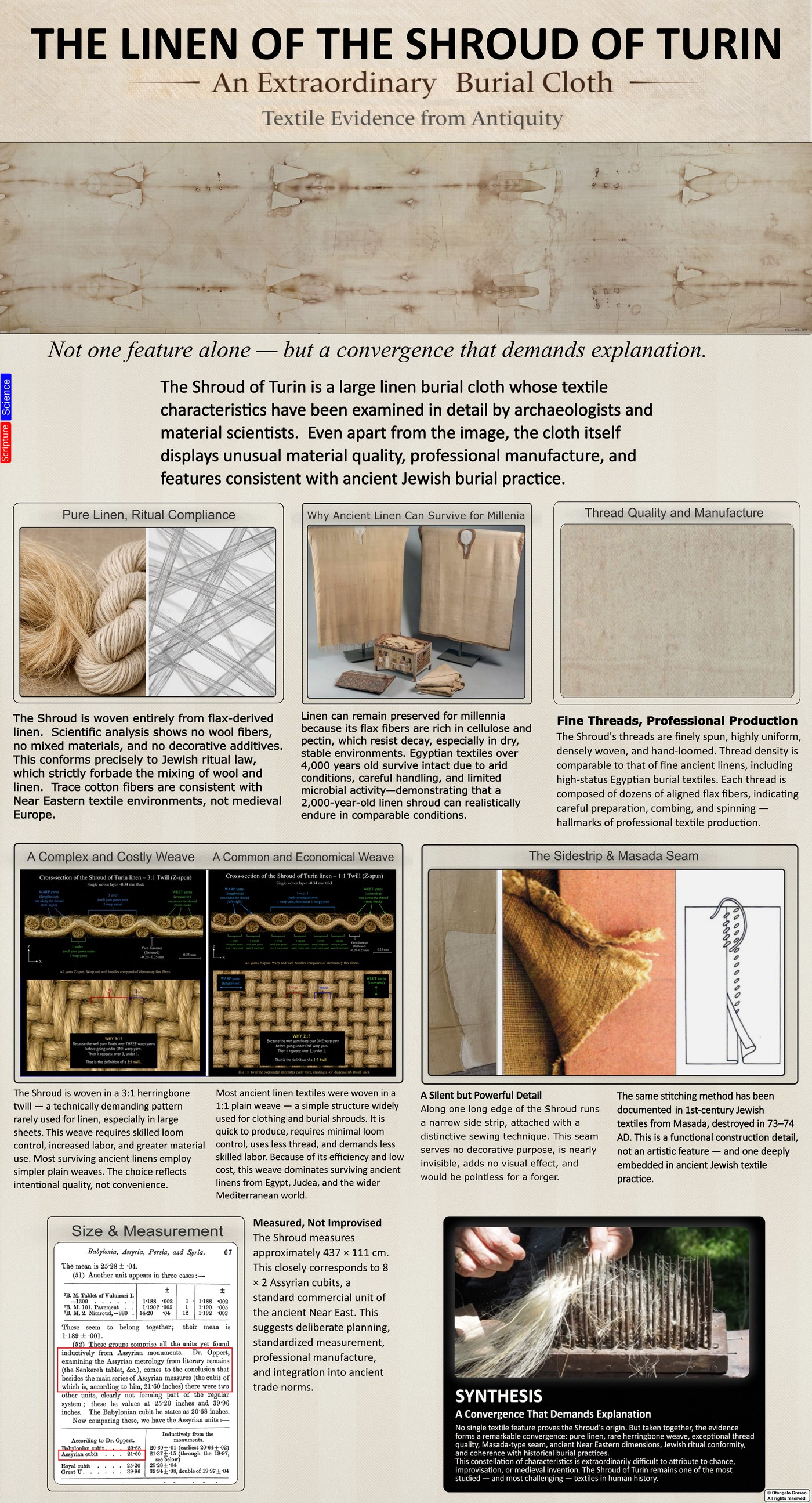
Before the image, before the blood, and before the radiocarbon result, there is the cloth. It is a length of linen about fourteen feet long, woven in a pattern that most ancient and medieval burial textiles do not use. Its fibres, its seams, and its dimensions are the first physical evidence any explanation has to account for.
This chapter asks what the linen can show. Textile study can describe how a cloth was made, which tools and skills it required, and how it compares with cloths of known date. It can rarely fix a date on its own. Much of the argument in this chapter turns on comparisons, and on the limits of those comparisons.
What the cloth is made of
The fibres are flax, the plant Linum usitatissimum. Flax fibres are long, strong, and rich in cellulose, which is one reason linen can survive for centuries in dry, stable conditions. Egyptian linen from more than four thousand years ago has survived in good condition, so the age of a linen cloth is not in itself a reason to doubt that it survives.
The cloth measures about 4.36 metres by 1.10 metres, roughly 14 feet 3 inches by 3 feet 7 inches. Along one long edge runs a narrow strip, about eight centimetres wide, which is joined to the main cloth with fine stitching. This is usually called the sidestrip. Its origin, and whether it was part of the cloth from the beginning, is one of the textile questions discussed below.
Measurements of individual fibres and yarns report average fibre diameters of roughly 13 micrometres, which is finer than a human hair. Reported cloth thickness and thread density place the linen among fine, lightweight textiles rather than coarse utilitarian cloth. These figures come from laboratory examinations and vary between reports, so they should be read as approximate.
The herringbone weave
The most distinctive feature of the cloth is its weave. It is a 3:1 herringbone twill: each weft thread passes over three warp threads and then under one, and the direction of the diagonal reverses at regular intervals, forming a chevron pattern. A simple plain weave, one thread over and one under, is the default for most ancient and medieval linen.
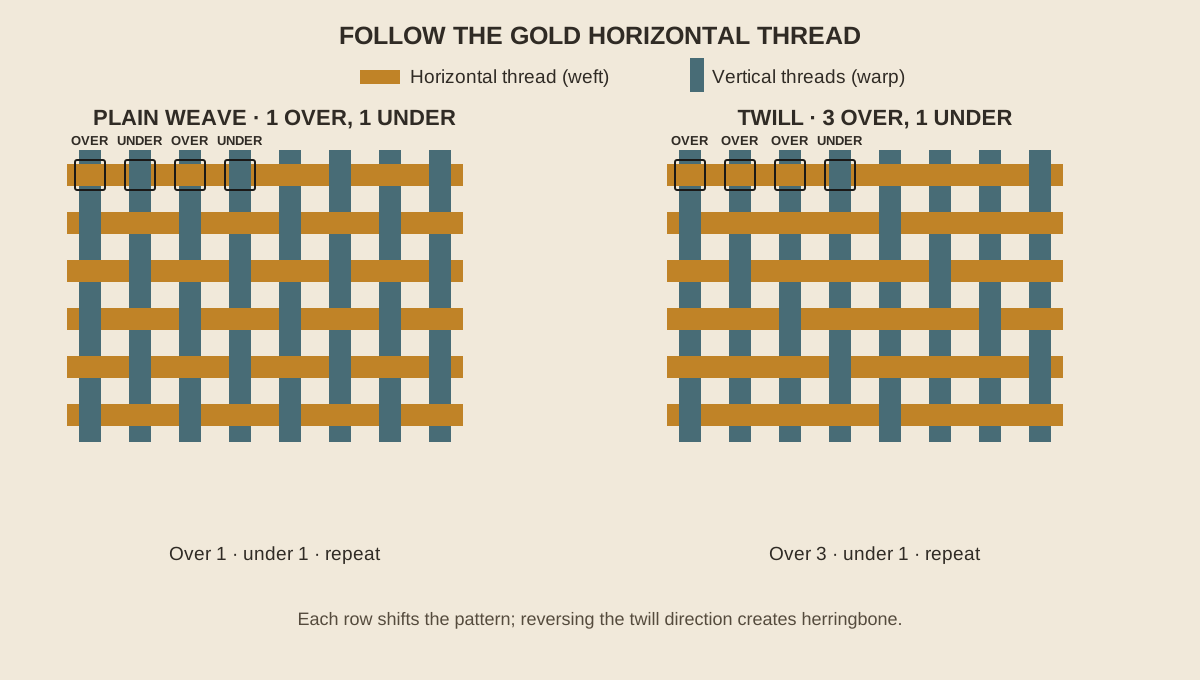
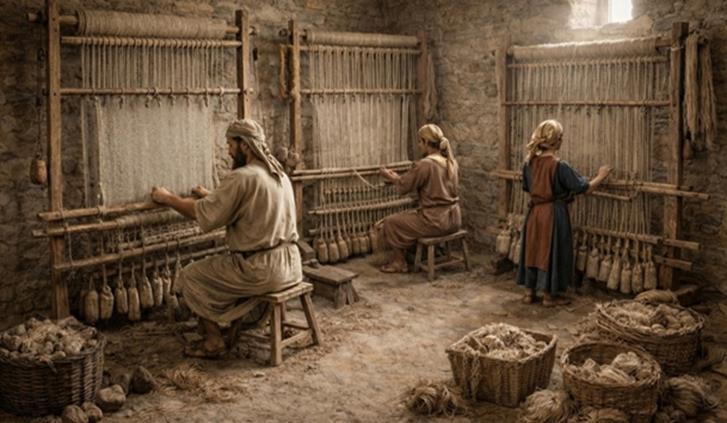
A twill of this kind needs a loom with several harnesses, usually four, to lift the warp threads in the required sequence. The weaver cannot produce the pattern on a simple loom, so the pattern itself points to a certain level of equipment and skill. It also costs more. A twill uses more yarn than a plain weave of the same size, takes longer to weave, and does nothing for the practical use of a burial cloth, since the body beneath it does not see the pattern.
Twill weaving was known in the ancient Near East and in medieval Europe. In medieval Europe it was more often used for wool and for textiles intended to be seen, while plain weaves dominated linen for practical use. The question is therefore not whether twill existed, but whether this particular combination of pattern, scale, thread density, and sidestrip technique has a documented parallel in the period to which the cloth is attributed.
Textile conservator Mechthild Flury-Lemberg, who examined the cloth in detail, has argued that the overall construction is more consistent with first-century Levantine practice than with documented medieval European linen.1 Critics respond that the surviving ancient record is very small. Linen decays easily, and the textiles that survive come mostly from desert caves and sealed tombs, which favour durable pieces rather than a representative range of cloth. A medieval workshop could also have copied an older technique deliberately. The absence of a parallel is therefore a reason for care, not proof in either direction.
The sidestrip and the Masada comparison
The sidestrip is the second textile question. Its edges are joined to the main cloth with stitching that is nearly invisible on the front, and the construction on the back is multi-stage. In 2002, while the 1532 repair patches were being removed for study and conservation, Flury-Lemberg examined the seam closely.1
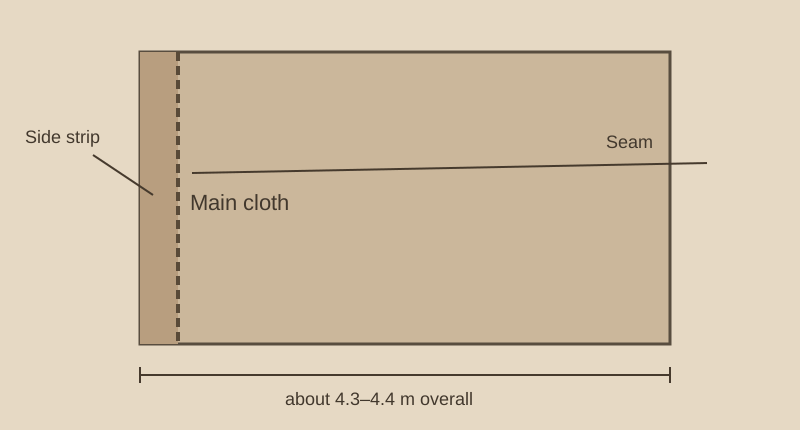
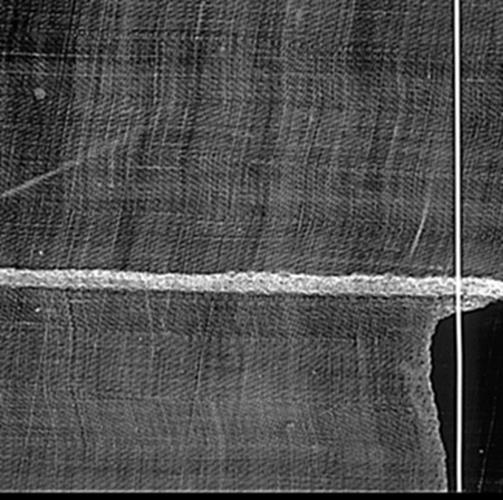
She reported a close similarity between this seam technique and a method found in linen fragments excavated from Masada, the fortress above the Dead Sea that fell to Roman forces in 73–74 CE. The Masada textiles were published in detail by Sheffer and Granger-Taylor in 1994.2 Their date rests on the archaeological context of the fortress, which is securely dated to the first century CE.
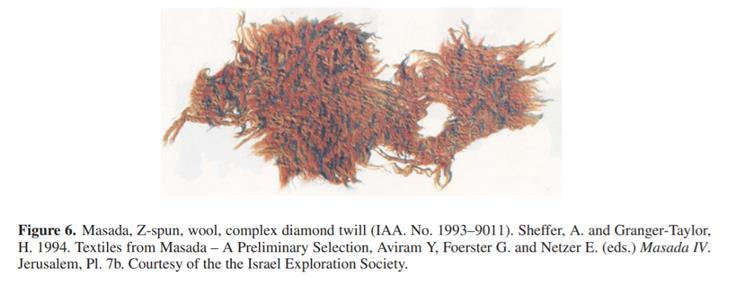
The comparison is significant only if the seam technique is distinctive enough to be unlikely in another period. That question remains open. A few considerations weigh in each direction:
- The Masada material is small, and the seam technique is documented from a limited number of fragments, so it is hard to say how widely the method was used.
- A medieval craftsman with access to an older textile, or to an older tradition, could have reproduced the method. The argument that no medieval textile worker had seen it depends on how completely the medieval record is known.
- The sidestrip could also be a later addition, a repair, or a piece joined at another time. Establishing when the strip was attached is a necessary step in using it as evidence of date.
Spin, twist, and continuity
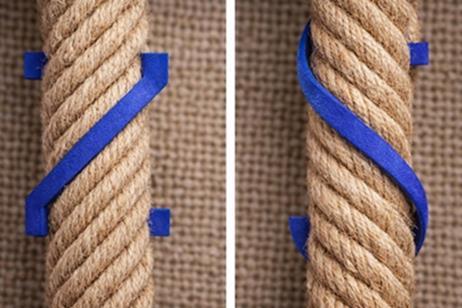
Flax yarn is spun in one of two directions, known as S-twist or Z-twist. Both are documented in ancient and medieval textiles, and the direction alone does not establish a date or a region. Some reports describe the Shroud’s yarn as Z-spun, and Flury-Lemberg has linked that to specific production traditions.1 Whether that link holds is a matter of further study.
The continuity of the yarn has also been discussed. Medieval spinning often left visible splices where one bundle of prepared fibre ended and the next began. Some examinations of the Shroud report smoother transitions, which would fit more easily with preparation methods used in the ancient Mediterranean. The point is suggestive rather than decisive, since smooth yarn is not restricted to any one period.
The absence of wool
Examined samples of the Shroud contain no wool. This matters because of a rule in Jewish law, shaatnez, which forbids mixing linen and wool in one garment (Leviticus 19:19; Deuteronomy 22:11). The rule was applied in practice, and it was especially important for burial cloths.3
Medieval European workshops often handled several fibres on the same equipment, and wool fibres from shared workspaces are common in medieval linen. A cloth with no wool at all is therefore unusual for a medieval production setting. That observation does not prove Jewish origin. A dedicated flax workshop that never handled wool would produce the same result, and so would a careful medieval producer. The absence is best read as one piece of negative evidence, consistent with several origins.
Dimensions and cubits
The cloth’s dimensions have been compared with ancient units of length. Some writers note that the length of about 437 centimetres equals eight cubits of about 54.5 centimetres, and the width of about 111 centimetres equals two such cubits. The Assyrian cubit was used in commerce across the Near East in the first century, and Jewish merchants continued to use it under Roman rule.
The arithmetic is accurate, but it is not strong evidence on its own. Many cloths were made to other dimensions, and the unit lengths cited are approximate. The sidestrip also complicates the picture: if the loom was slightly narrow, a strip could have been added to reach two cubits, but that explanation is itself a hypothesis. The dimensions are a point to record, not a basis for a date.
The 1988 sample and the reweaving question
The 1988 radiocarbon samples were taken from one corner of the cloth, close to the sidestrip region.4 The location of the sample has become central to the debate. Some researchers have argued that the corner was repaired or rewoven, and that a medieval repair would give a younger date than the rest of the cloth. The textile specialist Gilbert Raes proposed invisible reweaving as an explanation, and the idea has been discussed by others since. Testing the idea requires examining the corner itself, and that examination has not settled the question.
The date result and the textile results are different kinds of evidence. A radiocarbon date measures the age of the sampled fibres. A textile study describes how the cloth was made. Whether the sampled corner represents the whole cloth is a separate question that must be answered before the two sets of results can be combined.
What the linen can and cannot tell us
The linen can show that the cloth was made with considerable skill, from fine flax, on a loom capable of complex patterns. It can show that some of its features are documented in the ancient Near East. It can also show that some features, such as the absence of wool, are unusual for a medieval production setting.
It cannot, on its own, give a single date. Textile features are compared with other cloths whose dates are known, and the strength of the comparison depends on how complete those reference collections are. The ancient textile record is fragmentary, and medieval linen is also not fully documented. The sample used for dating, the sidestrip, and the repaired areas all need to be understood before any conclusion is drawn.
The next chapters look at the bloodstains and the wounds that the cloth records. The linen is the surface on which all of that evidence was left, and it is the first object that any explanation has to account for.
References
- Flury-Lemberg, M. (1988). Das Turiner Grabtuch und der Ursprung seines Bildes. Bern: Abegg-Stiftung.
- Sheffer, A., & Granger-Taylor, H. (1994). Textiles from Masada: a preliminary selection. In Y. Aviram, G. Foerster, & E. Netzer (Eds.), Masada IV. Jerusalem: Israel Exploration Society.
- Leviticus 19:19 and Deuteronomy 22:11, the laws on mixed fabrics (shaatnez). Text: Leviticus 19:19; Deuteronomy 22:11.
- Damon, P. E., et al. (1989). Radiocarbon dating of the Shroud of Turin. Nature, 337, 611–615. doi:10.1038/337611a0