The Shroud of Turin · Chapter 4 of 21
Silent witnesses: pollen and limestone
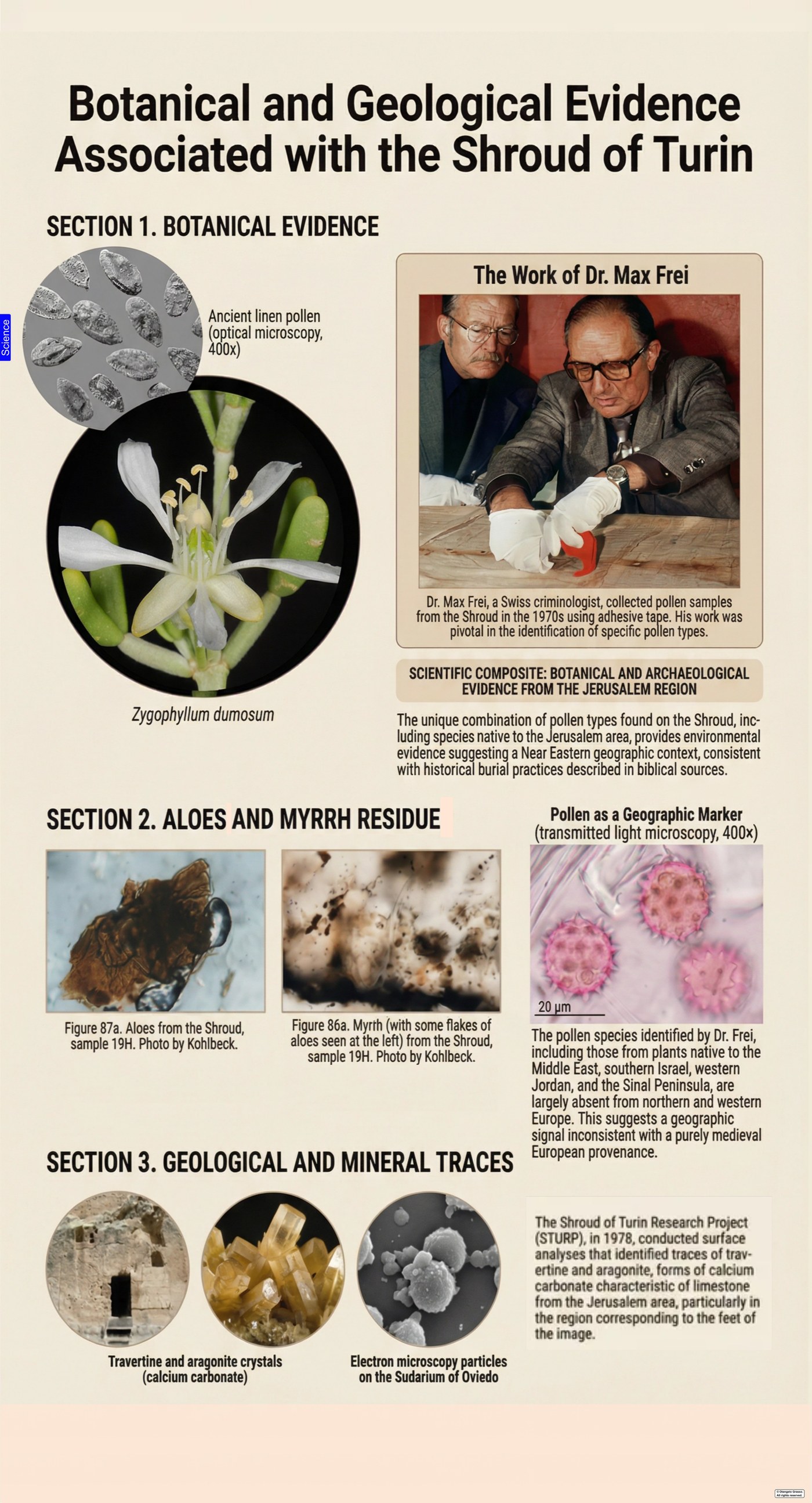
The cloth has been in European custody since the fourteenth century. Yet the fibres of its surface carry traces of plants and stone that grow in the eastern Mediterranean. Two sets of microscopic findings, made decades apart by different scientists, point to the same region. Both have also been challenged, and the challenges matter as much as the findings.
This chapter looks at the pollen and the limestone particles in turn, then at the objections to each, and finally at what the two lines of evidence can jointly support.
How the traces were collected
The traces were collected on adhesive tape. During the 1978 examination by the Shroud of Turin Research Project (STURP), the team sampled the surface with tape, and the materials on that tape were later studied under microscopes. Earlier, in 1973, the Swiss criminologist Max Frei-Sulzer had applied the same technique to the cloth, and he identified pollen on his tapes.1
The method matters for everything that follows. A tape lifts whatever is on the surface, including material that arrived after the cloth left its original context. The chain of custody of each tape, from the moment it was pressed on the cloth to the moment it was examined, determines how far a microscopic result can be trusted.
The pollen
Pollen grains have a tough outer wall, called the exine, which can survive for thousands of years. Their shape and surface pattern vary by species, though identification is often reliable only to the genus or family level. Forensic palynology uses pollen to show where and when material was deposited, and it is one of the few methods that can link a sample to a region.
Frei reported pollen from a large number of plant species on his tapes. He grouped them into three regions: the Mediterranean basin of France and Italy, the Anatolian steppe, and the Judean desert and Dead Sea basin. The three groups traced a route that matched the documented history of the cloth, from Jerusalem through Edessa and Constantinople to medieval Europe.1
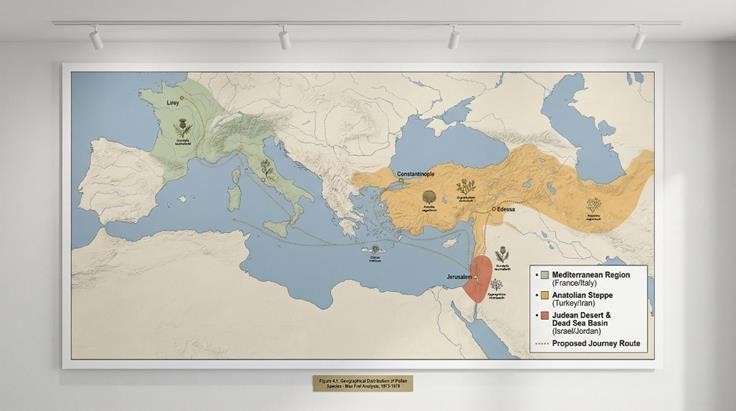
Two species carried most of the argument. The first is Gundelia tournefortii, a thorny thistle native to the Near East that flowers in spring, in the period of the Passover season. The second is Zygophyllum dumosum, a desert shrub whose natural range is restricted to Israel, Jordan, and the Sinai.2 Neither is known from medieval France or Italy.
In 1999 the botanist Avinoam Danin and the palynologist Uri Baruch re-examined 313 grains from Frei’s preserved tapes, and they reported the proportion of diagnostic species.2 Their re-examination is more rigorous than the original work, but it used the same tapes. It cannot independently test whether the grains came from the cloth, because it relied on the same handling history.
The objections to the pollen
Frei’s work has been criticised on several grounds, and these need to be stated plainly.
- Credibility and documentation. Frei was a respected forensic scientist, but he was among the experts who examined the Hitler Diaries in 1983, and the comparison samples in that case were later shown to be forgeries. Frei died in 1983 before he finished his planned monograph. Some of the scanning electron microscope images published in 1982 have been questioned because they resemble reference specimens from his own comparative collection.3
- Distribution on the tapes. After Frei’s death, one tape was reported to have a cluster on its lead end rather than on the part that touched the cloth. Critics argue that this points to contamination rather than deposition.3
- Pollinators. Many of the species Frei reported are insect-pollinated rather than wind-dispersed. Their pollen does not travel far by air, so its presence on the cloth suggests either direct contact with the plants or handling contamination.3
- Identification. In 2001 the palynologist Thomas Litt examined Frei’s tapes and reported that, because wax covered the grains, a precise identification at genus level was not possible. The key identifications have not been independently confirmed at the level the provenance argument needs.
A second line of work changed the reading of the pollen. Marzia Boi re-examined the tapes and argued that the most abundant grains were Helichrysum, a plant whose fragrant oil was used in ancient burial rites. In her reading the Gundelia grains are better explained as contamination, since the plant is common in the Mediterranean and its pollen is widespread in the air.4 On that view, the pollen is less a geographic passport than a residue of burial oils. Such oils and resins are described in Jewish burial practice of the first century, and the Gospel of John mentions a mixture of myrrh and aloes used in the burial of Jesus.5
Both readings point away from a medieval European origin, but neither has been settled. Forensic palynology normally requires contamination controls, such as pollen profiles of everyone and everything that handled a sample before its assemblage is read as a geographic signal. No such controls exist for the Shroud’s pollen record.6 The pollen is consistent with a Near Eastern origin, and it is also consistent with contamination after collection. The two cannot yet be told apart.
The limestone
The tapes also contained particles of limestone. In 1978 these particles attracted less attention than the pollen. Later, the optical crystallographer Joseph Kohlbeck examined tape samples sent to him after the examination, and he identified calcium carbonate in the form of aragonite, not the far more common calcite.7
The difference matters. Calcite is found almost everywhere, while aragonite forms under narrower conditions, particularly from calcium-rich spring water that deposits travertine. Travertine aragonite that contains certain trace elements, such as strontium and iron, can be geographically distinctive.8
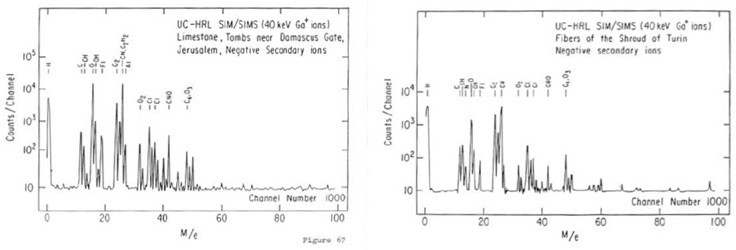
Kohlbeck and the archaeologist Eugenia Nitowski compared the Shroud particles with limestone from rock-cut tombs near Jerusalem, and they reported a match in mineral form and trace elements. Their results were published in Biblical Archaeology Review, a popular archaeology magazine rather than a peer-reviewed scientific journal.7 A follow-up field study in 1985–1986 sampled limestone at nine sites in Israel. Its report has not been published in a peer-reviewed journal, so its control series has not been independently checked.
The objections to the limestone
The historian Hugh Farey has raised the most detailed critique. He argues that the claims were inflated as they were repeated. Key STURP publications contain little on calcium particles, and the lead results do not match between the two analyses. He also notes that all limestone contains calcium, strontium, and iron, so a similar profile does not distinguish Jerusalem limestone from limestone elsewhere.9
Some of these points are strong, and others answer less than they seem to. The lead difference can be explained if the two instruments had different detection limits. The nine-site Israeli control series answers the question of specificity, but it has not been published in peer-reviewed form. The investigators themselves acknowledged that no rare-element marker has been found that would separate Jerusalem aragonite from aragonite elsewhere, and that no single particle proves where it came from.7
What the two traces can support
The pollen and the limestone come from different disciplines, were examined by different scientists, and were studied in different decades. They point to the same region, and that convergence is the main reason they are taken seriously. A medieval forger would have had to produce both the pollen from plants that grow only in the Near East and the mineral form of Jerusalem tomb limestone, placed in the places where a body touching the ground would be expected to leave it, the feet and possibly the nose.7
Neither trace proves an origin on its own. The pollen depends on handling history that was not controlled, and the limestone depends on a control series that has not been published. Together they are consistent with a Judean context, and they are harder to explain under a medieval European origin. They do not by themselves settle the question.
The radiocarbon result of 1988 points in another direction, and it is discussed in a later chapter. Any assessment of the pollen and limestone has to take that result into account. The trace evidence is one body of evidence among several, not a verdict on its own.
What we have learned
The blood, discussed in the previous chapter, records what happened to the body. The pollen and the limestone, discussed here, record where the cloth has been, at least as far as the tapes can show. Each finding has limits, and each has been challenged. The chapter that follows turns to the image itself, and to the photograph of 1898 that first revealed its negative form.
References
- Marinelli, E. (2012). The question of pollen grains on the Shroud of Turin and the Sudarium of Oviedo. Sindone.info. Review of the palynological research on the Shroud, including Frei-Sulzer’s 1973 and 1978 tape samples.
- Danin, A., Whanger, A. D., Baruch, U., & Whanger, M. (1999). Flora of the Shroud of Turin. St. Louis: Missouri Botanical Garden Press.
- Frei-Sulzer, M. (1982). Nine years of palynological studies on the Shroud. Shroud Spectrum International, 1(3), 2–7. Article scan.
- Boi, M. (2017). Pollen on the Shroud of Turin: The probable trace left by anointing and embalming. Archaeometry, 59(2), 316–330. doi:10.1111/arcm.12269.
- John 19:39–40. Text of the passage.
- Bryant, V. M., & Jones, G. D. (2006). Forensic palynology: Current status of a rarely used technique in the United States of America. Forensic Science International, 163(3), 183–197.
- Kohlbeck, J. A., & Nitowski, E. L. (1986). New evidence may explain image on Shroud of Turin. Biblical Archaeology Review, 12(4), 18–29.
- Fouke, B. W., Farmer, J. D., Des Marais, D. J., Pratt, L., Sturchio, N. C., Burns, P. C., & Discipulo, M. K. (2000). Depositional facies and aqueous-solid geochemistry of travertine-depositing hot springs. Journal of Sedimentary Research, 70(3), 565–585.
- Farey, H. (2021). Limestone on the Shroud. The Medieval Shroud. Online essay.